What a Sheet Laser Cutter Is and How It Is Used
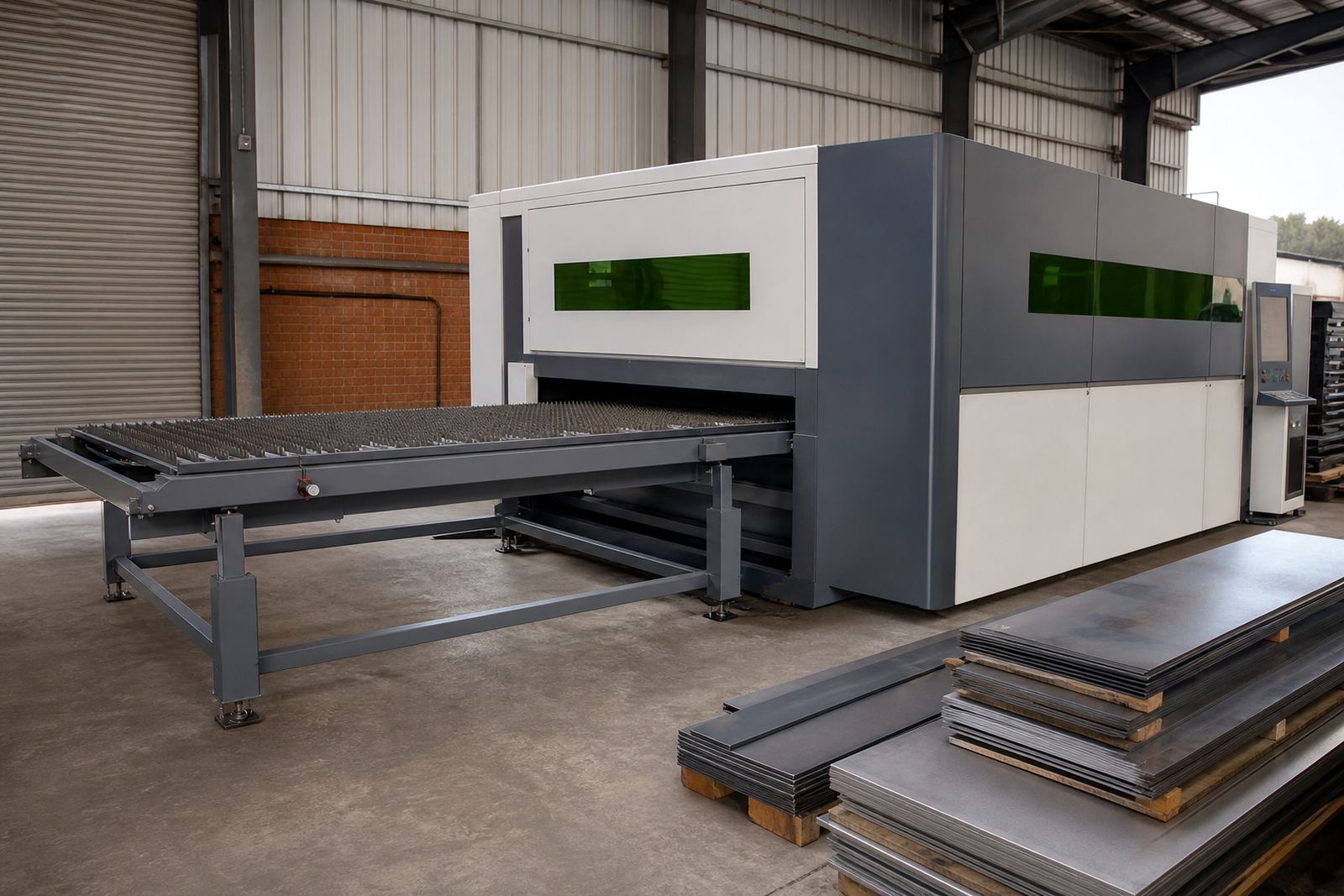
A sheet laser cutter is a flatbed cutting system used to cut plate and sheet material to size with a focused laser beam. It is common in job shops, fabrication yards, signage workshops, HVAC work, general engineering and production lines that need accurate repeat cuts on steel, stainless steel, aluminium and sometimes other materials depending on the setup.
These machines are usually sold as a complete system rather than a single unit. A typical package may include the cutting table, laser source, control cabinet, chiller, extraction or filtration unit, gas train, nesting software and loading or unloading aids. When valuing used systems, we look at the full installation because a working line is worth more than a machine that is missing key support equipment.
For auction purposes, the question is not only what the machine can do, but whether it is ready for removal, reconnection and recommissioning. A unit that was maintained well in a dry inland plant often presents differently from one used near the coast where humidity and corrosion can be an issue.
Typical Sizes, Formats and Options Buyers Ask For
Used sheet laser cutters are found in several formats. Smaller workshop machines may handle 1 250 x 2 500 mm or 1 500 x 3 000 mm sheets, while larger production units are often built for 2 000 x 4 000 mm, 2 500 x 6 000 mm or similar working envelopes. Some sites also use shuttle tables to speed up sheet changeover and keep the cutting head running for longer periods.
Power ratings vary by application. Entry and mid-range systems may be supplied with lower laser output, while heavier plate cutting needs higher output and stronger support equipment. Material thickness, pierce quality, edge finish and cutting speed all affect the right choice for a buyer. The size of the sheet also matters, because a machine that only handles smaller stock may not suit a fabrication yard that buys full commercial plate sizes.
- Working area: from compact shop units to full production format tables
- Laser source type: fibre, CO2 or other industrial cutting setups
- Table design: fixed bed, shuttle table, or pallet style loading
- Support gear: chiller, extraction, gas regulators and loaders
- Control system: manual nesting, CAM linked or integrated automation
Where These Machines Suit Best in South Africa
Sheet laser cutters suit businesses that need repeatable cutting with tight tolerances. In Gauteng they are often used by metal fabricators, contractors, equipment builders and repair shops in Kempton Park, Germiston, Midrand, Johannesburg and Pretoria. In Durban and Cape Town, buyers often look closely at corrosion protection and maintenance history because sea air can shorten the life of electrical components and sheet handling parts if the unit was not cared for properly.
These systems are also common in plants that run mixed production. A laser cutter can handle short runs and custom orders without the tooling cost associated with punching or stamping, which makes it useful for both high volume work and smaller contract jobs. For auction buyers, that flexibility can widen the buyer pool if the unit is in good running order and the cataloguing is clear.
At valuation stage, we consider the local market too. A machine that is easy to remove and commission in a Gauteng industrial area may attract stronger interest than one in a difficult-to-access site with lifting restrictions or limited truck access. The same applies to townships and industrial parks where loading hours, municipal rules and site security can affect sale planning.
Installation, Utilities and Site Requirements
Before a sheet laser cutter can run properly, the site must be able to support power, cooling, gas supply and extraction. Most systems need a stable electrical connection, correct phase supply and enough capacity for the laser source, chiller, drive system and ancillary equipment. On sites with load-shedding, buyers should plan for downtime risk, controlled shutdowns and safe restart procedures after power returns.
Gas needs depend on the material and cutting method. Oxygen, nitrogen and compressed air are common support gases, each with different implications for edge quality, cost and storage. Some systems also need dry, clean air and dependable filtration. If the compressor or gas supply is undersized, cut quality and uptime can suffer quickly.
- Electrical supply: matched to machine rating and local installation standards
- Cooling: chiller capacity suited to the laser source and ambient heat
- Gas: correct regulators, piping, cylinder storage or bulk setup
- Extraction: suitable for fumes, dust and fine metal particles
- Flooring and access: level base, enough room for loading, service and removal
When we inspect machines for auction or valuation, we also note if cabling, ducting and ancillaries are part of the sale. A complete removal plan saves time and reduces damage during collection.
Care, Servicing and Signs a Used Unit Has Held Value
Good maintenance shows in the details. Clean rails, tidy wiring, regular lens care, intact bellows, straight table sections and orderly gas lines usually point to better handling. Poor maintenance can show up as burn marks around the cutting head, damaged guide rails, noisy drives, coolant leaks, weak extraction and inconsistent cut quality. Rust around the table or control cabinet is another warning sign, especially in damp climates.
Routine servicing should include cleaning, alignment checks, coolant monitoring, optics inspection, filter changes and general safety checks. Any machine that has been used hard but serviced well may still hold value, while a neglected machine can be costly to recommission. That is why valuations are opinions of value, not guarantees of sale price. Actual sale outcomes depend on condition, market demand, timing and the equipment offered with the unit.
We also look at the paper trail where available. Service records, installation dates, manuals and maintenance logs help support a more accurate opinion. If these are missing, we rely more heavily on physical inspection and operational testing where possible.
What to Check Before You Buy or Send One to Auction
Whether you are buying or selling, a proper check of the machine and its support gear helps avoid disputes and wasted transport costs. The cutting head, table, source, chiller, extraction, drive system and software should all be identified clearly. If the system has been modified, that should be noted too because later changes can affect reliability and resale value.
For sellers, a clear catalogue entry matters. Buyers respond better when they can see the format, estimated capacity, included ancillaries and the machine’s general condition. For buyers, the main question is whether the machine will suit the material, thickness and output they need without expensive rework. It is worth checking removal routes, crane access, forklift needs and whether any special permits are required for site entry or transport.
- Confirm sheet size and working envelope
- Check the laser source rating and age
- List all included ancillaries and software
- Inspect cut quality, wear points and alarms
- Ask about service history, downtime and recent repairs
Machine Africa supports sellers and buyers with on-site valuations, auction planning, lotting and cataloguing, reserve guidance, viewing days, seller representation, collection coordination and closure support. For enquiries, clients reach us through the form on our contact page.
Key facts
| Product type | Used sheet laser cutting systems and handling equipment |
|---|---|
| Common sheet sizes | 1 250 x 2 500 mm to 2 500 x 6 000 mm |
| Typical support equipment | Chiller, extraction unit, gas regulators, loading aids |
| Materials commonly cut | Mild steel, stainless steel, aluminium |
| Power needs | Stable industrial electrical supply matched to the machine rating |
| Service focus | Valuation, auction planning, inspections, catalogue prep and collection coordination |