What a Reach Truck Is and Where It Works Best
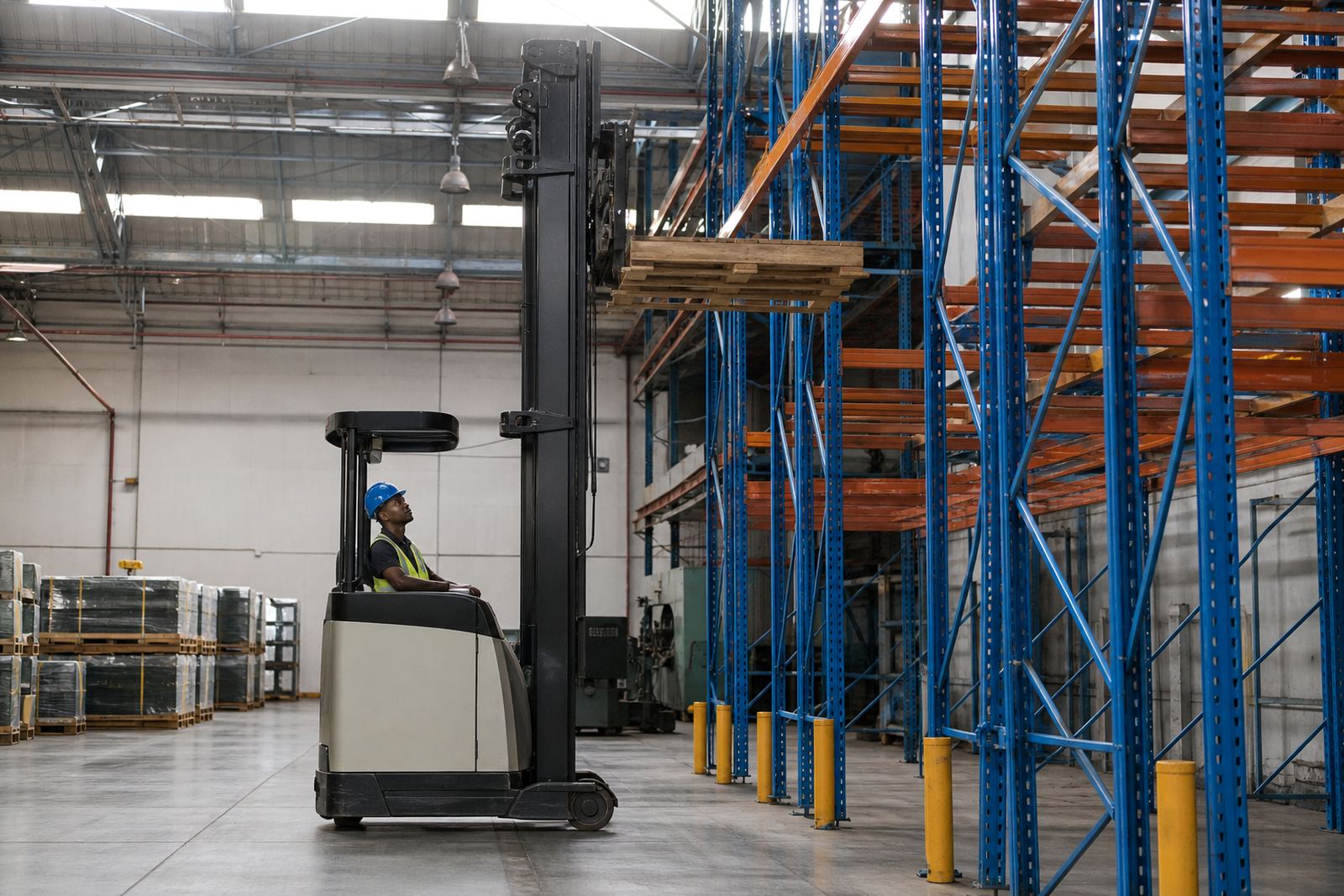
A reach truck is a warehouse lift truck built for stacking pallets in narrow aisles and racking. The forks move forward and back from the mast so the truck can place loads into rack positions without the whole chassis needing to enter the bay as deeply as a counterbalance forklift would. That makes it a strong fit for cold rooms, distribution centres, retail DCs, 3PL sites and any operation where floor space is tight.
In valuations and auction preparation, we look at how the truck has been used. A machine that spent its life on smooth indoor floors in a Kempton Park warehouse will usually present differently from one working in a dusty plant yard near Germiston or in a coastal store in Durban where humidity can affect electrics and connectors. The duty cycle, battery condition and mast wear all matter.
- Best for narrow-aisle racking and pallet storage
- Usually electric powered for indoor use
- More compact than many other lift truck types
- Useful where turning space is limited
Typical Sizes, Lift Heights and Capacity Options
Reach trucks are sold in a few common size bands, though exact specifications vary by model and age. Capacity is usually stated at a standard load centre, and that rating drops as lift height increases or when the load is carried further forward. For auction listing work, we record the rated capacity, mast configuration, battery details and wheel type so buyers can judge fit for purpose.
Common options include 1.4 tonne, 1.6 tonne and 2.0 tonne units, with many trucks offering lift heights from about 5 metres up to 11 metres or more. Some are stand-on models for faster order picking, while others are sit-down units for longer shifts. Side-shift, camera systems, fork positioners and cold-store packages are also seen on the market.
- Capacity bands often range from 1.4 to 2.0 tonnes
- Lift heights commonly run from 5 m to 11 m+
- Load centre and mast height affect working capacity
- Options can include side-shift, cameras and cold-store spec
Where a Reach Truck Suits the Operation
These machines suit businesses that need tight-aisle storage and frequent pallet movement. They are widely used in food storage, wholesale distribution, apparel, pharmaceutical stores and import warehouses around Johannesburg, Pretoria, Cape Town and Gqeberha. In many sites, they are the best choice where a standard forklift is too wide or too clumsy for the aisle layout.
For auction buyers, we point out the floor condition and aisle requirements as well as the machine itself. A reach truck can perform well in a clean indoor operation, but it is not the right answer for rough yards, gravel or uneven loading areas. If your site has ramps, door thresholds or mixed floor levels, that must be checked before purchase. A clean battery does not help if the warehouse lanes are too narrow or the racking height is not matched to the mast.
- Ideal for racked warehousing and pallet storage
- Works best on smooth internal floors
- Not suited to rough outdoor terrain
- Check aisle width and rack height before ordering
Installation, Charging and Power Requirements
Most reach trucks are electric and need a suitable charging area, proper ventilation and a safe electrical supply. The charger setup depends on the battery voltage and charger size, and the site must allow for cable management and battery access. In Gauteng warehouses, load-shedding often means buyers also need to consider backup power or a charging plan that fits operating hours. Without that planning, a good truck can sit idle at the wrong time.
Installation is usually less about bolting in machinery and more about setting up the support space. That includes charging bays, battery handling gear, fire precautions and traffic flow around the warehouse. In coastal areas like Durban or Cape Town, extra attention should be paid to corrosion, terminal condition and moisture ingress. Where the unit has been stored outside, we look closely at connectors, tyres and the mast channel condition too.
- Usually needs a matched battery and charger set
- Requires a dry, ventilated charging area
- Plan for backup power during load-shedding
- Inspect cables, plugs and battery trays for wear
Care, Servicing and Common Wear Points
Reach trucks need regular attention to keep their lift performance safe and consistent. Daily checks should cover battery water levels where applicable, fork condition, mast rollers, hydraulic leaks, steering response and warning systems. Weekly or scheduled servicing usually includes lubrication, brake checks and inspection of the lift chain, mast rails and contactors. If the truck is used in cold storage, extra care is needed because moisture and temperature changes can speed up wear.
When we prepare a truck for auction, we note visible faults, missing parts and signs of poor maintenance. Buyers usually want honest detail on battery age, tyre condition, charger compatibility and whether the unit was last used in production or only stored. A truck with tidy body panels can still need major attention underneath, so photos and inspections must go beyond the paint. For sellers, clear records improve the lot description and help buyers make a proper decision.
- Check mast rollers, forks and hydraulic hoses
- Record battery age and charging condition
- Watch for corrosion on terminals and connectors
- Test brakes, steering and warning alarms before use
What to Check Before Ordering or Sending to Auction
If you are buying a reach truck, confirm the rated capacity, maximum lift height, battery voltage, charger details and the exact mast type. Ask whether the unit comes with side-shift, whether the tyres are cushion or polyurethane, and whether the battery holds charge under normal working conditions. If the machine is going into a high-rack warehouse, the reach and residual capacity should be checked against the actual load weight and lift height. That part is often missed and it can cause trouble later.
If you are selling, gather the serial number plate, service history, battery information and any repair notes. A full inspection helps with valuation because an opinion of value is based on condition, duty level and market demand, not a guarantee of sale price. For auction preparation, we also look at site access for collection, whether the truck is live and driveable, and if any dismantling will be needed before removal. Good paperwork and clear photos make the process easier for everyone.
- Confirm rated capacity and lift height
- Check battery voltage and charger match
- Verify mast type, tyre type and side-shift
- Keep service records and serial details ready
Key facts
| Type | Electric warehouse reach truck |
|---|---|
| Common capacity range | 1.4 to 2.0 tonnes |
| Typical lift height | About 5 m to 11 m+ |
| Power requirement | Battery powered with matched charger |
| Best use | Narrow-aisle pallet storage and racking |
| Typical working environment | Indoor warehouses, cold rooms and distribution centres |