
What a Pedestal Drill Is and Where It Fits
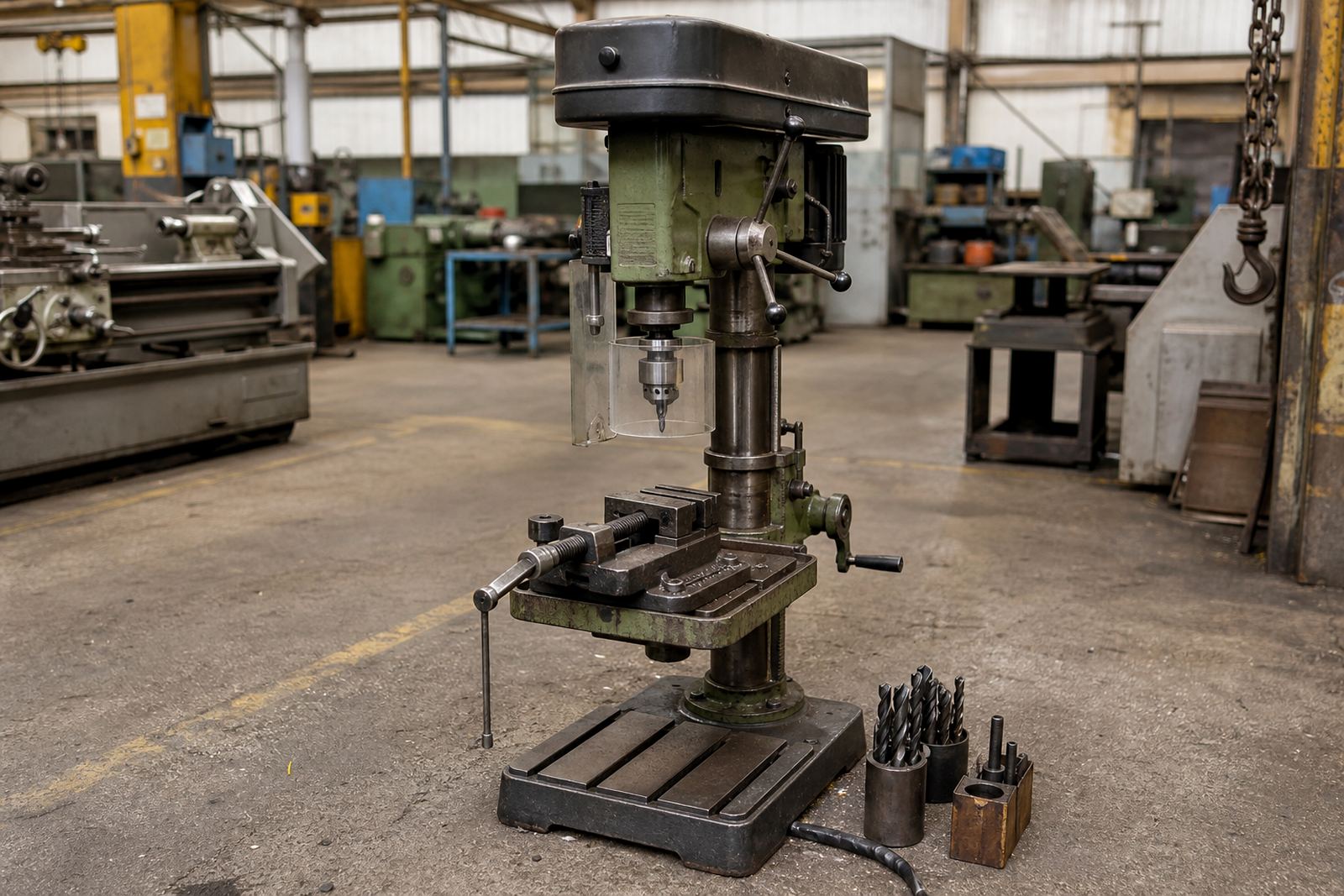
A pedestal drill is a floor standing drilling machine built on a column or pedestal, with the head mounted above a table and base. It is used for accurate hole making in steel, aluminium, timber and plastics, and is common in fabrication shops, maintenance yards, toolrooms and agricultural workshops. On used machinery listings, buyers often look at spindle travel, table size, motor size and the condition of the feed mechanism before they bid.
These machines suit regular drilling work where hand drills are too slow or too inconsistent. A good pedestal drill gives better control for repeat holes, counterboring, reaming and light tapping. In busy shops around Johannesburg, Pretoria and Durban, it is often kept close to the saws and benches so operators can move material through quickly, though the machine still needs enough floor space for safe handling.
Common Sizes, Speeds and Workshop Options
Used pedestal drills are listed in a wide range of sizes, from smaller units for light repair work to heavier drills for fabrication and production. Buyers should check the swing, which is the distance from the spindle centre to the column, because that tells you the largest diameter workpiece the machine can handle comfortably. Speed range matters as well, especially when drilling different materials.
- Table size: often around 250 mm to 600 mm square or round
- Spindle travel: commonly 80 mm to 200 mm, depending on model
- Drilling capacity: from about 13 mm on light units to 32 mm or more on heavier machines
- Speed range: fixed or stepped speeds, often from low drilling speeds for steel to higher speeds for timber and plastics
- Motor size: usually single phase on smaller units or three phase on workshop machines
Some machines include a vice, depth stop, coolant tray, tilting table or tapping function. A heavier unit may also have a geared head for more torque at lower speeds. For auction catalogues, we note these details clearly so bidders can compare one lot with another without guesswork.
Power, Installation and Workshop Conditions
Most pedestal drills need a stable floor, proper anchoring where required, and a power supply that matches the motor rating. Smaller machines may run on 230 V single phase power, while larger workshop drills often need 400 V three phase supply. Before moving one into a new site, buyers should confirm the available supply, the condition of the isolator and whether the machine will start under load without tripping. In places affected by load-shedding, a buyer should plan for restart procedures and sensible switchgear, because repeated interruptions can be hard on older controls.
Installation also depends on the workspace. The machine should stand level, with enough room for the operator to feed material safely and enough clearance for long stock. In coastal areas such as Cape Town, Gqeberha and Durban, humidity can affect surface rust, bearings and electrical connections, so storage and inspection matter. Pedestal drills used in dusty or outdoor yards may also need closer attention to the belts, pulleys and motor ventilation.
- Check whether the machine is single phase or three phase
- Confirm the supply voltage and start-up condition
- Make sure the floor is level and the base can be secured if needed
- Allow space for feed handles, table movement and workpiece clearance
- Inspect cables, plugs, guards and emergency stops before use
Care, Servicing and Typical Wear Points
Used pedestal drills can last well when they are kept clean, lubricated and set up properly. The main wear points are the spindle bearings, belts, chuck, feed handles, quill return spring and table clamp. If a machine has been used for many years on heavy work, there may be play in the spindle or signs that the quill does not return smoothly. Noise under load, vibration and rough bearing feel are all worth noting in a valuation.
Routine care is fairly simple. Keep swarf off the column and table, check belt tension, lubricate moving parts according to the machine type and make sure the chuck key is never left in place. A machine that has been stored outdoors or in a damp shed may need a more detailed clean before it can be tested properly. We often advise sellers to have the machine powered and checked before the auction listing is prepared, so the lot condition is easier to describe with confidence.
What Buyers Should Check Before Ordering
When buying a used pedestal drill through an auction or private sale, the safest approach is to inspect the machine carefully and ask for the main operating details. A valuation is an opinion of value based on condition, specification and market demand, not a guarantee of sale price. The final auction result depends on buyer interest, timing, access and how the machine is presented.
- Confirm drilling capacity and spindle travel
- Check for free movement in the quill and smooth table adjustment
- Look at the chuck condition, belt wear and guard completeness
- Test the motor start, stop and any reverse function
- Ask if tooling, vice or drill bits are included in the lot
- Inspect the base and column for damage, cracks or welding repairs
For workshop managers in Germiston, Midrand or Kempton Park, it is worth checking whether the machine can be moved through doors, ramps and tight passages before collection. A drill that looks modest on paper may still need proper lifting gear, palletising or machine skates to move safely.
How We Present Pedestal Drills for Auction
For each pedestal drill, we prepare a practical lot description, carry out an inspection where possible and gather clear photographs for listing. The goal is to show the machine as it is, with honest notes on condition, visible wear and any missing items. Good photo listing prep helps bidders judge the table, head, motor plate, wiring and overall finish before viewing day.
Our team handles lotting and cataloguing, viewing days, seller representation, reserve guidance and closure support. Where a site has several related machines, we can separate them into sensible lots so buyers understand what they are bidding on. That can help with clearance sales, workshop upgrades and asset disposals in Johannesburg, Pretoria, Durban, Cape Town and Gqeberha, as well as surrounding areas such as Kempton Park, Germiston and Midrand. If a machine needs collection coordination after the sale, we help manage the process from the seller side so removal is orderly and practical.
Key facts
| Machine type | Floor standing drilling machine with column, table and base |
|---|---|
| Typical power | 230 V single phase or 400 V three phase, depending on model |
| Drilling capacity | About 13 mm to 32 mm plus on many used units |
| Spindle travel | Commonly 80 mm to 200 mm |
| Typical features | Stepped speeds, depth stop, vice, tilting table, guard |
| Best suited for | Fabrication shops, maintenance workshops, toolrooms and light production |