What an edge bander does in a workshop
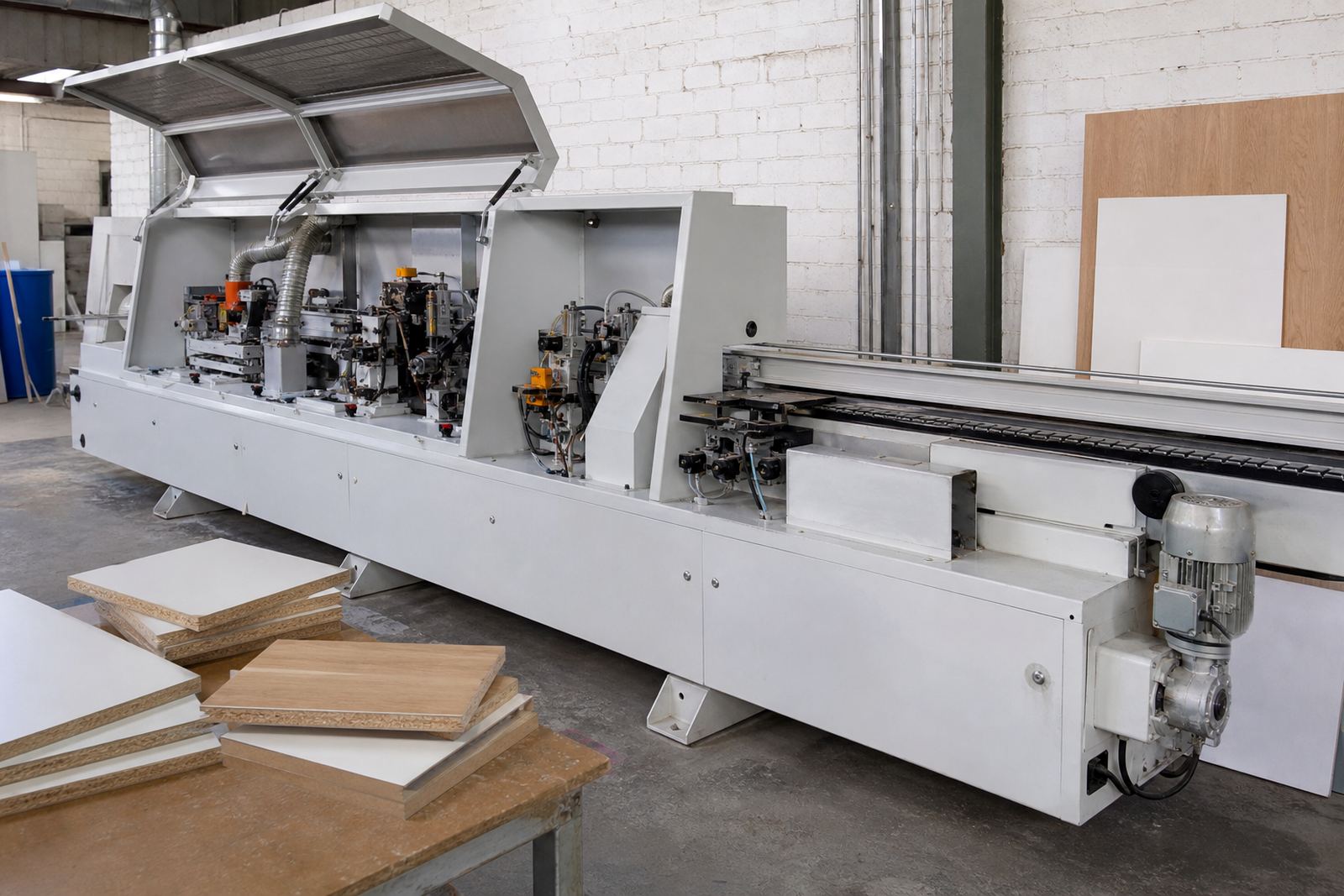
An edge bander is used to apply a finishing strip to exposed board edges on panels, cabinets and fitted units. In a busy joinery shop it saves time compared with hand finishing, and it gives a cleaner edge on melamine, MDF, particleboard and plywood. The machine usually trims, glues, presses and finishes the edge in one pass, which is why condition and setup matter so much when buying used.
For auction buyers, the main point is not only whether the unit switches on. You need to know how straight it feeds, whether the glue system heats properly, if the pressure rollers hold material evenly, and whether the trimming stations still cut cleanly. A well kept machine can give years of service, but a neglected one can be costly to bring back into production.
- Suitable for cabinet shops, shopfitting yards and panel processing plants
- Commonly used with PVC, ABS, veneer and solid wood edging
- Can be manual feed, semi automatic or fully automatic
Typical sizes and machine options
Used edge banders come in several sizes, from compact workshop units to heavier industrial machines with multiple stations. A small unit may be fine for a local cabinet maker in Germiston or Midrand, while a larger line is better for a production floor turning out repeated runs. Options usually depend on edging type, panel thickness, feed speed and the amount of finishing required.
Many machines on the market include pre-milling, glue pot or cartridge glue systems, end trimming, top and bottom trimming, corner rounding, scraping and buffing. Some have automatic feed, while others need more operator input. When we provide a valuation opinion, we look at build quality, age, working order, hours used where available, and whether the controls and safety systems are complete.
- Manual, semi automatic or automatic feed systems
- Edge thickness commonly from 0.4 mm to 3 mm, sometimes more on heavier units
- Panel thickness range often around 10 mm to 60 mm, depending on model
- Single phase units suit smaller workshops, while larger machines often need three phase power
Where edge banders suit local production
Edge banders are common in furniture manufacturing, fitted kitchen production, office fit-out work and general panel processing. In coastal areas such as Durban and Gqeberha, buyers often pay close attention to rust, humidity damage and electrical wear. In inland areas, dust build-up and poor maintenance can be the bigger issue, especially where load-shedding has interrupted normal running and machines were not shut down properly.
For auction sellers, it helps to know what the machine was doing before it was retired. A unit that spent its life in a clean production bay with regular servicing is generally easier to place than one that stood outside or ran with frequent faults. Buyers want to know if it was part of a steady production line, a backup machine, or a workshop unit used only from time to time. That context can change how the machine is viewed in the market.
- Best suited to cabinet shops, joinery operations and light industrial factories
- Works well where panel sizes are repeatable and edges need consistent finishing
- Useful for sellers closing a workshop, upgrading equipment or clearing surplus stock
Power, air and setup checks before installation
Before a used edge bander is moved onto site, the buyer should check the available power supply, air supply and floor space. Many industrial units need a stable three phase supply, proper earthing and a compressor with enough pressure and volume for consistent operation. Some also need extraction to manage dust and glue fumes, especially in enclosed workshops. If the machine has been idle for a while, seals, hoses and wiring should be checked before full start-up.
Installation is not just about placing the machine in a straight line. There must be room for infeed, outfeed, maintenance access and operator movement. On a narrow site, the machine can become awkward to use even if it is in good order. When planning a purchase, measure the floor area, gate access, doorway widths and forklift space. If the machine must move through a shared industrial yard in Kempton Park or Pretoria, collection planning should be handled carefully.
- Confirm supply voltage, phase and breaker capacity before collection
- Check compressor needs, extraction points and air line condition
- Allow space for loading, feeding, trimming and maintenance access
- Make sure the floor is level enough for stable feeding and alignment
What to inspect when ordering at auction
When ordering a used edge bander through auction, the safest approach is to inspect the machine with a clear checklist. Start with the feed system, cutter heads, glue section, electrical cabinet and safety guards. If the machine is complete but needs small repairs, that can still be workable. Missing guards, damaged controls or severe rust often mean a bigger repair bill than expected.
Valuations are opinions of value, not guarantees of sale price. They are based on condition, demand, size, make, and the strength of the market at the time. An auction can return a fair result when the lot is described well, photographed properly and viewed in person before bidding. That is why lotting, catalogue notes and viewing days matter. Sellers should disclose faults, while buyers should ask direct questions and inspect for heat damage, worn rollers and glue system build-up.
- Check trimming heads, pressure rollers and guide tracks for wear
- Inspect glue pot, heaters, hoses and wiring for damage or leaks
- Confirm guards, emergency stops and control panels are present
- Ask about spare parts, manuals and any recent servicing
Care, servicing and storage between jobs
Edge banders last longer when glue residue is cleaned out regularly and the cutting heads are kept sharp. Dust and adhesive build-up can affect the finish and place strain on the drive system. In busy plants, a simple daily wipe-down and a proper weekly clean can prevent a lot of downtime. If the machine is stored during shutdowns or seasonal slow periods, it should be protected from moisture, especially in coastal humidity.
Servicing should include checking belts, bearings, sensors, heater elements, air lines and electrical connections. If a machine has been standing after load-shedding events or a long closure, it should be started under supervision rather than rushed into full output. Good care does not only protect the machine, it also supports a more useful valuation when the time comes to sell. Even a well kept unit still needs honest assessment, because age and usage leave marks that buyers will notice.
- Clean glue residue and dust after use
- Keep blades, cutters and rollers in workable condition
- Store under cover to reduce rust and moisture damage
- Record service history and any fault repairs for the next buyer
How Machine Africa handles edge bander valuations and auctions
From our Kempton Park base, Machine Africa assists sellers and buyers with on-site valuations, auction planning, lotting and cataloguing, asset inspections, reserve guidance, viewing days, seller representation, collection coordination, clearance sales, closure support, plant appraisals and photo listing prep. Our team, led by Siyabonga Mthembu, works with Naledi Khumalo, Pieter van der Merwe, Ayesha Ismail, Thabo Molefe, Johan Botha and Lerato Nkosi to manage the practical steps from inspection to handover.
For edge banders, a careful process matters because condition can vary widely from one workshop to the next. We look at the machine as a working asset, not just a steel frame with a motor. That means checking completeness, transportability, likely commissioning needs and the market for similar equipment in Johannesburg, Durban, Cape Town, Gqeberha, Pretoria and beyond. If you need to sell one machine or clear an entire plant, an organised process makes the result easier to manage.
Clients reach us through the enquiry form on our contact page when they need a valuation opinion or auction support. We then assess the machine, describe it fairly and handle the next steps in a way that suits the site and the equipment. Clear details help both sides, and that is what buyers usually want most.
Key facts
| Machine type | Edge bander for panel edge finishing |
|---|---|
| Common edging range | 0.4 mm to 3 mm, depending on model |
| Typical panel thickness | About 10 mm to 60 mm |
| Power | Single phase or three phase, model dependent |
| Air supply | Compressed air commonly required for clamps and pneumatics |
| Typical functions | Glue application, trimming, scraping, rounding and buffing |