What a process chiller unit does in plant and production
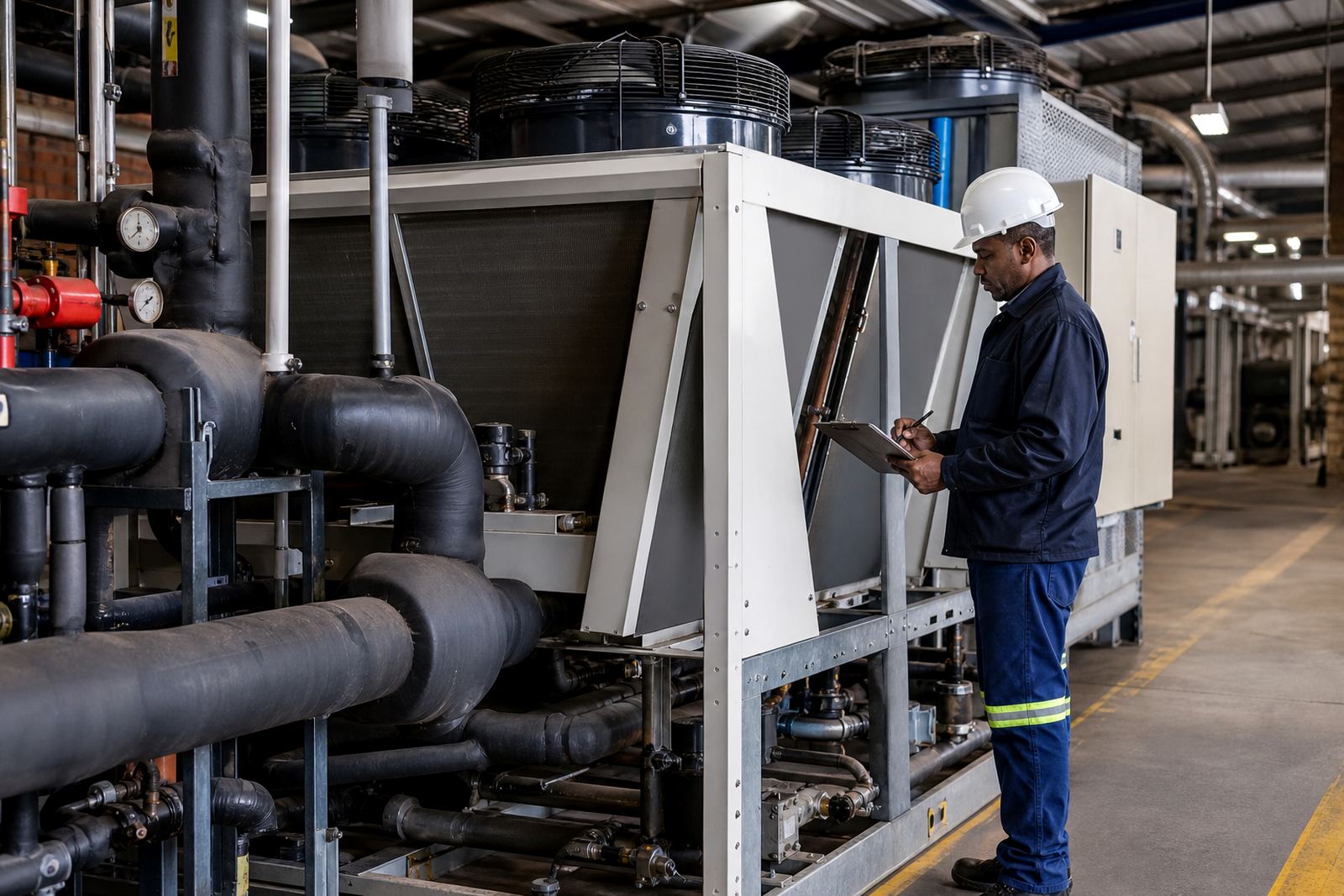
A process chiller unit removes heat from water or a glycol mix and sends the cooled fluid through equipment that needs stable temperature control. In food processing, plastics, packaging, printing, chemical blending and light manufacturing, that can mean fewer stoppages and more consistent output. The unit may sit beside a press, moulding machine, laser cutter, test rig or filling line, depending on the plant layout.
When we assess a used unit, we look at the plate data, compressor count, condenser type, refrigerant, pump arrangement and the general state of the frame and controls. Valuations are opinions of value based on condition, age, duty and market demand, not a guarantee of sale price. For auction campaigns, that distinction matters because buyer interest can shift depending on access, service history and whether the unit is ready to run.
- Air-cooled units suit yards and factories with limited water supply.
- Water-cooled units are often chosen where cooling water and plant room space are available.
- Portable units are useful for temporary plant cover or short-term capacity needs.
Common sizes, cooling ranges and configuration options
Used chiller units are sold in many capacities, from compact workshop units to larger industrial machines with multiple compressors. A smaller unit might serve a single machine or a test bench, while larger systems can support several process points at once. Size is usually described by cooling capacity, pump size and tank volume, so buyers should compare the full set of numbers rather than look at the frame only.
Typical options include single-circuit or multi-circuit systems, built-in tanks, integral pumps, remote condensers and fitted filters. Some units are designed for chilled water only, while others are arranged for glycol mixes where lower fluid temperatures are needed. In coastal cities such as Durban and Gqeberha, corrosion resistance and cabinet condition can be important, especially where salt air has reached the unit over time.
- Cooling capacity: often quoted in kW or tons of refrigeration.
- Fluid temperature range: check minimum and maximum setpoints.
- Pump head and flow rate: match these to the pipe run and plant demand.
- Tank volume: affects start-up stability and load fluctuation.
Where a used chiller suits best in South Africa
Used chiller units suit sites that need dependable process cooling without long lead times. We see them in Johannesburg and Germiston metal shops, Pretoria plastics plants, Midrand distribution operations, and larger production sites in Cape Town, Durban and Gqeberha. They also come up in provincial plants where a spare unit is kept for backup during maintenance or load-shedding related interruptions.
The right unit depends on your plant conditions. If the machine room is tight, airflow and service access matter. If the site is dusty, filters and coil cleaning become more important. In humid coastal conditions, a buyer should inspect cabinet rust, electrical enclosures and any signs of water ingress. For outdoor installations, good drainage and a level base are essential, otherwise vibration and poor condensate management can become a problem.
- Manufacturing lines with steady heat loads.
- Temporary cooling for shutdowns, commissioning or repairs.
- Backup support where downtime would be costly.
- Sites with municipal water limits that favour closed-loop cooling.
Installation, power supply and site preparation
Before a used chiller is moved, the buyer should confirm the electrical supply, breaker size, cable route and whether the plant has a suitable changeover arrangement for outages. Many industrial units run on three-phase power, and the starting current can be significant. If the site relies on generators, the generator must be sized for both the running load and start-up demand, not only the nameplate figure.
Some models need water connections for condenser cooling or a closed chilled-water loop with pumps and strainers. Others need clear airflow around the condenser and enough space for maintenance panels to open fully. Level floors, vibration isolation and proper pipe support make a real difference. We have seen units perform poorly simply because the installation was rushed and the pipework was too narrow, or the return line was badly routed.
- Confirm voltage, phase and frequency before collection.
- Check whether the unit needs chilled water, glycol or both.
- Allow access for forklifts, rigging or a crane if the unit is large.
- Plan for drain points, bunding and safe hose routing.
Care, servicing and the signs of a tired unit
Routine care usually starts with clean coils, clear strainers, checked refrigerant levels and sound electrical connections. Belts, fans, contactors, sensors and pump seals should also be reviewed at service intervals. In hot inland areas such as Gauteng, dust can build up quickly and reduce heat transfer. On the coast, the same unit may face moisture and corrosion instead. Either way, a neglected chiller can become expensive to keep running.
During valuation or auction inspection, we look for oil leaks, unusual noise, repeated trips, damaged insulation, bypassed safety devices and evidence of hurried repairs. A machine that still runs may still be a weaker asset if the service record is thin or if key parts are missing. Buyers should ask for the logbook, commissioning notes and any recent service report. If the unit has been idle for months, it may need a proper recommissioning rather than a quick switch-on.
- Clean the condenser and inspect the fins for damage.
- Check controls, alarms and safety cut-outs.
- Inspect hoses, valves, pumps and vibration mounts.
- Look for service stickers, records and past fault notes.
What to check when ordering or bidding on a used chiller
When you are ordering or bidding on a used chiller unit, start with the rating plate and the actual condition. Do not rely on the outer casing alone. Check the serial data, refrigerant type, compressor count, year of manufacture if shown, and whether the unit is complete with pumps, tank, controls and guards. If the unit is being sold as-is, make sure you understand what is included and what is not.
Buyers should also confirm transport height, width and weight, because chiller units can be awkward to move through narrow plant entrances or low roofs. Access roads, loading bays and rigging points matter just as much as the cooling duty. At auction, viewing days are the best time to inspect the unit properly and ask questions before the lot closes. Sellers can also benefit from a clear lot description, because good catalogue information helps the market understand the machine without overpromising anything.
- Match the cooling duty to your actual process requirement.
- Confirm the unit comes with the parts you need to install it.
- Check whether any testing was done before sale.
- Measure the space at the new site before collection is arranged.
How Machine Africa handles valuations and auction campaigns
Our Kempton Park base supports sellers and buyers across South Africa with on-site valuations, asset inspections, auction planning, lotting and cataloguing, viewing days, reserve guidance and closure support. For used chiller units, that means the asset is assessed in context, whether it is part of a single machine sale or a full plant clearance. We focus on clear descriptions, condition notes and practical sale preparation so both sides know what is being offered.
Led by Siyabonga Mthembu, our team includes specialists who handle auction management, senior valuation work, client relations, operations, site logistics and catalogue preparation. We work with industrial machinery in Johannesburg, Pretoria, Durban, Cape Town, Gqeberha, Germiston and Midrand, and we handle collection coordination and seller representation where needed. If you need a used chiller unit valued or entered into an auction campaign, send your enquiry through the contact page form and we will take it from there.
- On-site checks for condition and completeness.
- Photo listing prep and lot description support.
- Viewing day planning for interested buyers.
- Clearance sales and post-sale close-out support.
Key facts
| Unit type | Used process chiller unit |
|---|---|
| Cooling media | Chilled water or glycol mix, depending on model |
| Typical power supply | Three-phase electrical supply, model dependent |
| Cooling configuration | Air-cooled or water-cooled |
| Common applications | Process cooling for manufacturing and plant equipment |
| Sale context | Used machinery valuation and auction campaign asset |