What We Look At When Valuing Air Compressors
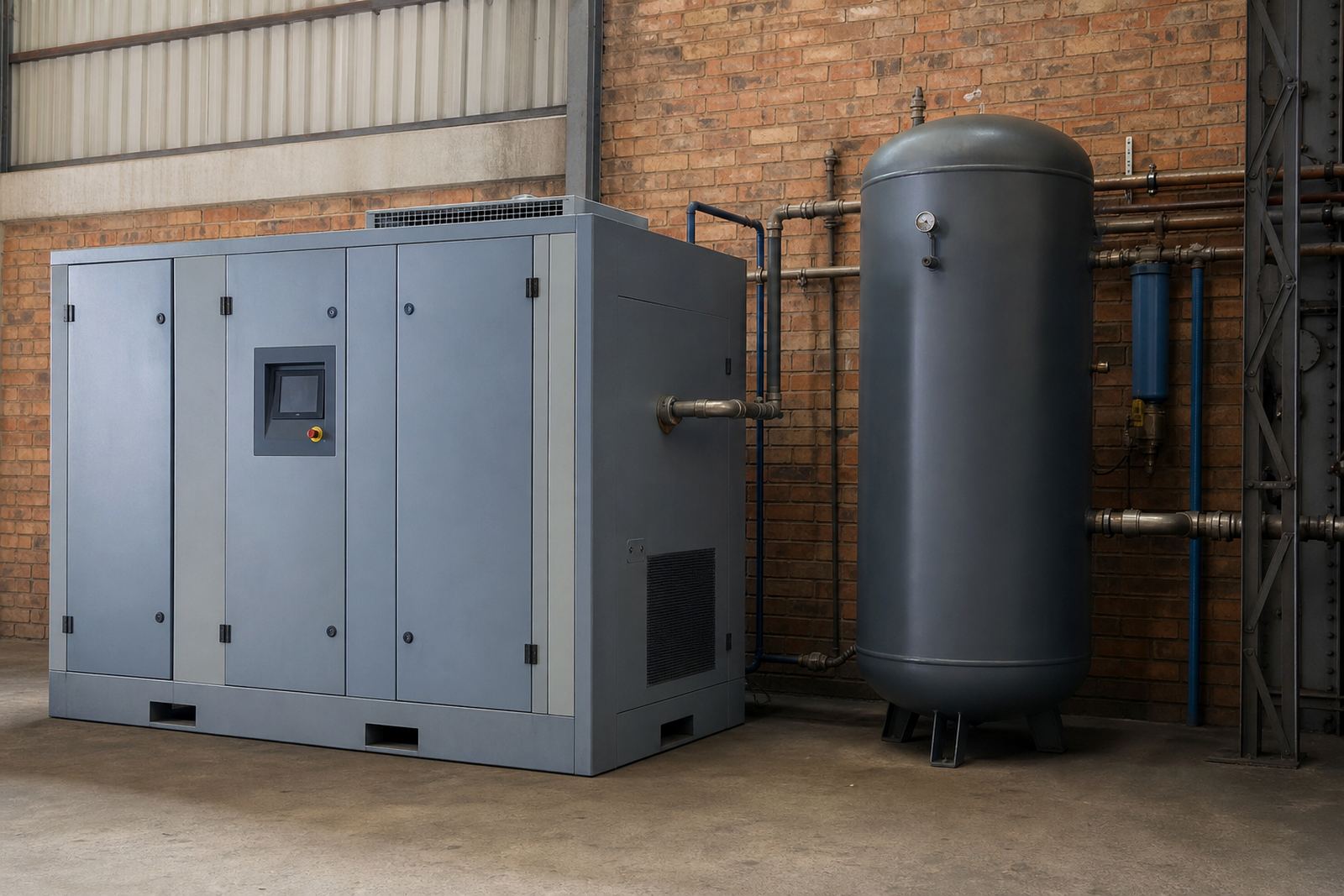
An air compressor valuation is an opinion of value based on the machine as it stands, its working condition, age, use history and how well it matches current demand. It is not a guarantee of sale price. For used compressors, we also check the receiver, controls, motor, belts, cooling system, piping, moisture traps and any drying plant that forms part of the setup.
In Kempton Park, Johannesburg and Pretoria, many units come from factories, workshops, warehouses and maintenance stores where the machine may have run long hours, but still need a close check for wear, oil carryover and pressure losses. On coastal sites in Durban, Cape Town and Gqeberha, humidity and salt air can affect pipework, valves and electrical parts, so corrosion matters. Load-shedding and voltage dips can also leave signs in starters, contactors and motor condition.
- Fixed or portable compressors are valued differently
- Receiver size and pressure rating affect use and demand
- Single-stage and two-stage units suit different duties
- Air dryers, filters and tanks can add practical value
Common Sizes, Types and Working Ranges
Air compressors are supplied in many sizes, from small workshop units to larger industrial packages used for production lines, tyre shops, fabrication, spray booths and maintenance teams. Typical used machines may range from 2 hp to 250 hp and above, with receiver tanks from 100 litres to several thousand litres. Small workshop units often run on 220 V single-phase power, while larger plant usually needs 380 V to 400 V three-phase supply. Some sites use diesel-driven portable sets where grid power is limited.
In auction cataloguing, it helps to separate the compressor from the receiver, dryer, aftercooler and any storage tank if those items are sold together or separately. We also note whether the unit is oil-lubricated, oil-free, belt driven or direct drive, as each has its own maintenance profile and buyer demand.
- Workshop units for light intermittent air tools
- Medium plant units for assembly, sanding and packaging
- High-output systems for production and continuous use
- Portable diesel units for site work and construction
Where Air Compressors Suit Best
These machines suit many operations that need compressed air for tools, clamping, cleaning, inflation, spraying or process control. They are common in general engineering, panel shops, timber yards, tyre depots, food handling areas, logistics sites and farm workshops. The right compressor depends on airflow demand, duty cycle and how clean the air must be for the application.
For buyers, a compressor that looks serviceable on the outside may still be wrong for the job if the receiver is undersized or the output cannot meet peak demand. A spray booth needs steadier delivery and better drying than a basic workshop line. A fabrication shop may need a stronger unit for grinders, impact tools and intermittent high draw. If the site has municipal or building limits on noise, enclosure and placement must also be checked.
- Engineering and metalworking workshops
- Tyre and fitment centres
- Packaging, assembly and maintenance lines
- Spray painting and cleaning applications
Installation, Power Supply and Site Checks
Before a compressor is moved or auctioned, the installation details should be recorded carefully. Buyers need to know the power requirement, starter type, cable size, ventilation needs and whether the machine was hard wired or plugged in. Larger units may need a suitable breaker, isolated room, level floor and enough airflow around the cooler and motor. If the package includes a receiver, the tank plate should be checked for pressure rating, service date and any signs of repairs or bulging.
For sites in Gauteng, many compressors are tied into three-phase systems, while smaller units may be used in back-up setups during outages. In coastal areas, rust on tank supports, drain points and fittings can become a real concern, so inspection should include all low points where water collects. If the machine was run in a dusty yard or close to grinding work, blocked filters and worn cooling fins are common.
- Check incoming supply voltage and phase requirement
- Confirm ventilation and drainage around the installation point
- Inspect receiver tank condition and pressure plate markings
- Look for oil leaks, overheating marks and noisy bearings
Care, Servicing and What Buyers Should Ask For
Used compressors tend to perform better when they have been drained regularly, serviced on schedule and kept free of dirt around the intake. Routine care includes oil changes where applicable, belt checks, filter replacement, condensate draining and inspection of valves, gauges and pressure switches. If a unit has been idle for a while, seals can dry out and moisture may sit in the receiver or lines.
When ordering or bidding, buyers should ask for the service history where available, whether the machine has been tested under load and whether any parts are missing. It is also sensible to ask about the age of the receiver, the condition of the motor starter and whether the dryer or separators are included. A compressor that starts and builds pressure at idle may still struggle once the tank reaches working pressure, so load testing is useful.
- Request service records and recent repair notes
- Ask if the unit builds and holds pressure properly
- Check whether spare filters, belts or drains are included
- Confirm if the receiver and dryer form part of the lot
Auction Planning For Compressors And Plant
For sellers, clear lotting makes a difference. Compressors may be sold on their own, bundled with receivers and dryers, or grouped with other plant from the same workshop. Good photo listing prep, proper asset inspections and clear catalogue notes help buyers understand what they are looking at before viewing day. It also reduces uncertainty on site and supports better bidding.
At our Kempton Park base, we handle auction planning, seller representation, reserve guidance, collection coordination and closure support for used industrial machinery across South Africa. For compressor lots, the key is to state what was tested, what was not tested and any visible defects. If there are safety notes, access limits or removal requirements, those should be explained early so buyers can plan properly.
- Separate or bundle lots to suit the market
- Describe testing, defects and missing items clearly
- Include removal access, lifting points and transport notes
- Arrange viewing days for serious buyers before sale
Key facts
| Typical power | 220 V single-phase or 380 V to 400 V three-phase, depending on size |
|---|---|
| Common sizes | 2 hp to 250 hp and above |
| Receiver capacity | 100 litres to several thousand litres |
| Air delivery | Approx. 200 l/min to 4 000 l/min+ depending on model |
| Pressure range | Usually 7 bar to 13 bar for general industrial use |
| Common setup | Compressor, receiver tank, filters, dryer, drains and controls |