Used Injection Moulders In Plant Context
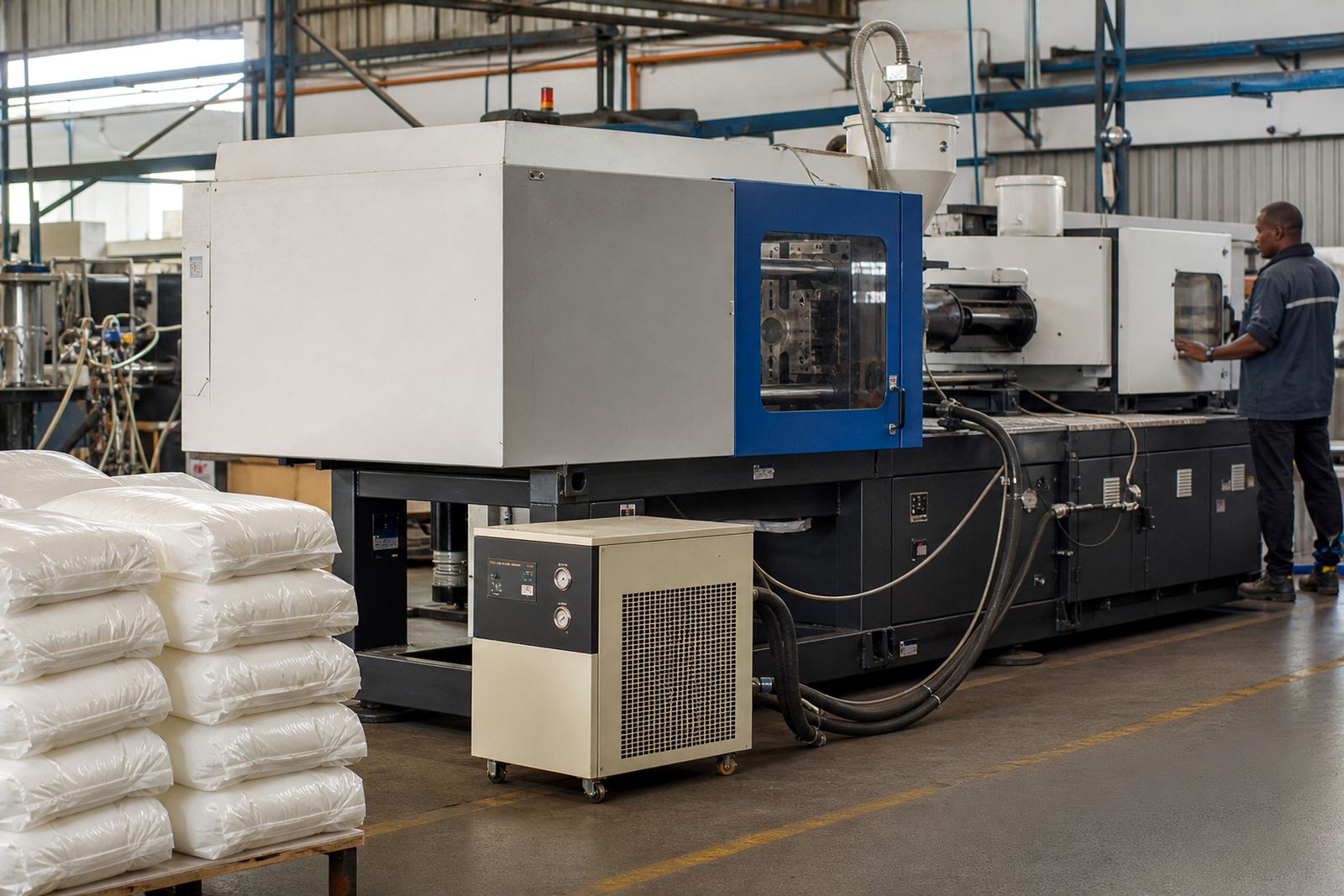
Injection moulders are used to produce plastic parts by heating polymer, forcing it into a mould, then cooling and ejecting the finished item. In South African plants they are common in packaging, auto components, household fittings, caps, crates and technical plastic parts where repeatability matters. When a machine comes to valuation or auction, the main question is not only what size it is, but how it has been used, maintained and fitted into the line.
For sellers in Germiston, Midrand or Kempton Park, the machine may still be installed on a live floor with dryers, chillers, conveyors and mould storage nearby. That plant context matters. A 120 tonne unit in good condition can be more useful to one buyer than a larger machine with worn screws, a tired hydraulic system or missing guards. Valuations are opinions of value based on inspection and market knowledge, not a guarantee of sale price.
Common Sizes, Clamp Force And Build Options
Used injection moulders range from small bench-style or compact floor units to large production machines with high clamp force and heavy platens. Capacity is usually described by injection shot size, screw diameter, tie-bar spacing and clamp tonnage. Some buyers want a compact machine for short runs, while others need a higher tonnage unit for larger moulds or multi-cavity tools.
- Small machines: about 20 to 80 tonne clamp force, suited to light parts and lower output lines.
- Mid-range machines: about 100 to 300 tonne clamp force, common in general plastics production.
- Large machines: 350 tonne and above, used for bigger moulds, thicker parts or higher moulding pressure.
- Options to note: hydraulic, all-electric or hybrid drive, single or multi-stage injection, and core pull functions.
When preparing a machine for auction, the serial plate, model details, control type and installed options should be captured clearly. If the seller has moulds, robots or ancillary equipment, these can be listed separately if required.
Where Injection Moulders Suit Production Work
Injection moulders suit businesses that need repeatable plastic parts with controlled weight and finish. They are found in workshops and factories making caps, containers, electrical housings, fittings, appliance parts and many custom items. In coastal areas like Cape Town and Gqeberha, corrosion resistance and storage conditions deserve more attention because humidity can affect cabinets, electrics and surface rust. In Gauteng, dust and load-shedding can influence how well the machine has been protected between shifts.
Before sale or relocation, buyers often want to know if the machine is suited to continuous production, short runs or tool changes. They may also ask whether the machine can handle a mould with high closing pressure, fast cycle times or specific barrel temperatures. These details influence both usability and value.
- Check the mould size and platen space against the machine tie-bar spacing.
- Confirm whether the machine needs auxiliary equipment such as dryers, chillers or a hopper loader.
- Match the clamp force to the part size and mould requirements.
- Look at the control panel language, alarms and available process memory.
Installation, Power Supply And Support Services
Most used injection moulders need stable electrical supply, correct phase configuration and proper earthing. Larger units may require a three phase supply with sufficient amperage, and some lines also need compressed air, chilled water and temperature control units. If a buyer is moving a machine to Pretoria or Durban, transport and offloading must be planned around mass, access height and floor loading. A machine might fit the floor plan but still need lifting gear, rollers or a service corridor to get into position.
Installation should also consider the condition of cabling, hydraulic hoses, oil cleanliness and the state of the safety circuits. A buyer should never assume a machine will run as soon as it is placed on site. Commissioning, mould setup and first trials can reveal hidden faults or missing ancillaries. For auction listings, clear photos of the electrical cabinet, hydraulic unit and platen area help buyers judge what is included.
- Power: usually three phase, with supply sized to the machine and heaters.
- Cooling: water line or chiller connection is often required for the mould and barrel control.
- Air: some machines need compressed air for valves, ejection or ancillaries.
- Flooring: level concrete with enough load capacity for the machine weight.
What To Check Before Valuation Or Auction
When assessing a used injection moulder, the first step is to establish the make, model, year and configuration, then inspect how the machine behaves mechanically and electrically. A good valuation looks at more than appearance. It should consider clamp smoothness, screw and barrel condition, hydraulic leaks, heater bands, safety doors, limit switches and the control system. If the machine has been idle for some time, seals and electronics may need extra attention.
Buyers should also ask for practical running details if available, such as last production use, service history, moulding materials processed and any fault codes that still recur. In many plants, minor issues are acceptable if the machine is priced and described honestly. That is why clear lotting and cataloguing matter. It helps buyers understand what they are bidding on and helps sellers avoid disputes after the sale.
- Inspect the screw, barrel and nozzle for wear or leakage.
- Check clamp movement, platen alignment and tie-bar condition.
- Test the control screen, alarms, heaters and emergency stops.
- Confirm whether manuals, spare parts and tooling are included.
Care, Servicing And Preparing For Sale
Routine care keeps a machine more saleable and easier to move. That means cleaning around the hopper, removing loose resin, draining unwanted fluids where appropriate and making sure the machine is isolated before inspection. If the unit is still in service, regular checks on hydraulic oil, filters, heater bands, cooling lines and guarding can reduce downtime. A machine that has been left unprotected in a dusty warehouse often presents differently from one kept in a working production bay.
For auction preparation, presentation counts. Straightforward cleaning, proper photo listing prep and a clear record of included parts can improve buyer confidence. Machine Africa assists with on-site valuations, auction planning, asset inspections, reserve guidance, viewing days, seller representation, collection coordination and closure support. That support matters when the seller needs a practical route from production floor to sale day, especially where clearance deadlines are tight or the site needs to be vacated in stages.
Ordering Details Buyers Should Confirm
Before ordering or bidding on a used injection moulder, buyers should confirm the exact machine size, the moulding application and the site conditions at the destination. A machine that looks suitable on paper may still need extra work if the power supply, cooling capacity or floor layout is not ready. In South African industrial settings, it is sensible to plan for transport delays, municipal access rules and the realities of plant shutdown windows. If a buyer is moving equipment between Johannesburg and Cape Town, lead times and lift plans need attention as well.
It is also wise to check whether the machine is being offered as a stand-alone unit or as part of a full production line. Some buyers want only the moulder, while others need the hopper dryer, mould temperature controllers, robots or conveyors too. Good enquiry details help everyone save time and avoid confusion. The more accurately a machine is described, the easier it is to assess whether it fits the next job.
- Confirm clamp tonnage and shot size against the intended mould.
- Check voltage, phase and total power demand before transport.
- Ask what ancillaries are included and what must be sourced separately.
- Review access at the destination for offloading and positioning.
Key facts
| Machine type | Used injection moulding machine for plastic part production |
|---|---|
| Typical clamp force | About 20 tonne to 1,000 tonne plus, depending on model |
| Key checks | Clamp condition, screw wear, hydraulics, electrics, safety systems |
| Power needs | Usually three phase electricity, sized to machine and heaters |
| Support equipment | Cooling, compressed air and material handling may be required |
| Use cases | Packaging, fittings, housings, caps, crates and custom plastic parts |