Bakery Equipment Sale Brief in Cape Town
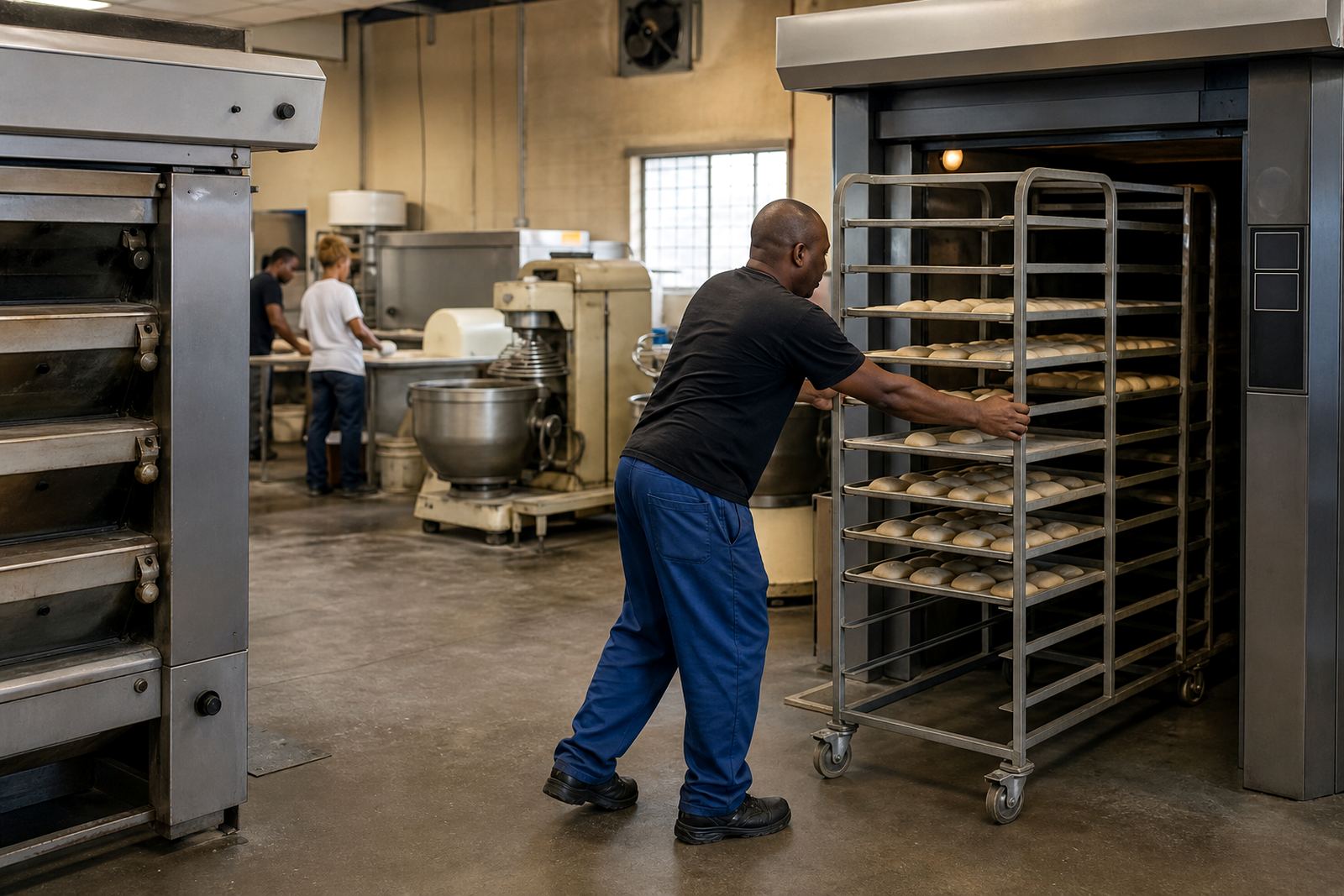
The client was a food production business in Cape Town that needed to release surplus bakery machinery while keeping the line presentable for buyers. The main focus was on used deck ovens, spiral and planetary mixers, dough dividers, tray trolleys, cooling racks and conveyor style tray handling equipment.
We were asked to assess the plant, guide the sale format and prepare the assets for auction in a way that would attract serious bakers, plant managers and second hand equipment dealers. The site had normal bakery pressures to manage too, including flour dust, tight access around production areas and time windows that had to fit around shifting work and cleaning cycles.
The valuation work was based on opinion of value, not a promise of sale price. We looked at age, duty cycle, condition, service history where available, electrical requirements, gas connections on heating units, wear to belts and guards, and how easy each item would be to remove and recommission elsewhere.
What We Needed to Work Around
Two practical issues shaped the project from the start. First, bakery machinery is often heavy and awkward to move, so collection planning had to allow for narrow doorways, floor protection and safe lifting points. Second, buyers in this sector usually want to know whether a machine can be put back into service quickly, so we had to present the lot details clearly and honestly.
- Mixed equipment condition, with some items still installed and others already disconnected
- Space constraints around ovens and tray racking areas
- Electrical and gas considerations on certain machines
- Coordination required with site staff to avoid interrupting operations
- Need for accurate photos and measurements for remote bidders
We also had to keep the message straight forward. A buyer needs facts such as chamber size, tray capacity, motor ratings, dimensions and whether the machine is complete with stands, controls and guards. If those details are vague, the auction room gets quieter and bids tend to follow. That part is simple but easy to get wrong.
Our Valuation and Auction Process
We carried out an on-site valuation and walked the plant with the client team to confirm the assets that would be included. Each major item was checked for model type, visible condition, wear, missing parts and whether any accessories should be sold together or split into separate lots. For bakery plants this matters because one machine may be useful on its own while another only has value as part of a working set.
After that we built the auction plan, prepared the lotting structure and drafted catalogue notes for each item. Photo listing prep was handled with close-up images of control panels, heating surfaces, mixer bowls, gearboxes and tray carriers so bidders could make informed decisions before viewing. Reserve guidance was discussed with the seller where needed, always as guidance rather than a guaranteed outcome.
- On-site valuation and asset inspection
- Lotting into logical groups for bakery buyers
- Catalogue notes with dimensions and key machine facts
- Viewing day planning for local and out of town bidders
- Collection coordination after the sale
Timeline From Inspection to Sale Close
The project ran over six weeks from first inspection to close out. Week one covered the site visit, asset list confirmation and initial valuation. Week two was used for lotting, photography and catalogue preparation. Week three included viewing arrangements and seller sign off on the listing details. The auction itself was run in week four, with post sale administration and collection planning continuing into weeks five and six.
That timing worked well because bakery assets often need a bit of preparation before they are market ready. Some machines were disconnected and labelled on site while other items needed cleaning, basic testing and clear identification of power requirements. The short lead time was manageable because the seller stayed organised and our team kept the process moving without unnecessary back and forth.
For buyers, the schedule gave enough time to inspect, ask questions and work out transport. That is important for heavy bakery machinery, especially when items may need loading with a forklift or crane and later reinstallation in a production setting.
Results For Buyer Interest and Seller Control
The sale attracted interest from bakeries, food processors and machinery resellers looking for usable plant at second hand level. The strongest response was for the ovens and mixer units, with tray handling equipment also drawing attention from operators who were trying to improve output without replacing an entire line.
From the seller side, the main benefit was control. The assets were presented clearly, the description matched what buyers could inspect, and the removal process was handled in a measured way. That reduced the risk of disputes and helped keep the closure process organised. In this kind of sale, transparency matters as much as price.
We would not claim a single number as the result because each auction is different and valuation is only an informed opinion. What we can say is that the structured listing, careful inspection notes and practical viewing setup gave the right kind of market response for this type of equipment.
What We Would Do Again
The same approach would suit another bakery machinery sale in Cape Town or elsewhere in South Africa. We would again start with a site walk, confirm exactly what is included and separate the sale into lots that make sense to real users. That means keeping machines together when they work best as a set, and splitting them when individual sale value is stronger.
We would also keep pushing for clear machine facts early. Tray count, bowl capacity, oven chamber dimensions, power supply, and visible condition notes all help buyers make decisions faster. In a market where some equipment may have seen coastal humidity, heavy daily use or periods of shutdown during load-shedding, honest reporting protects both sides.
- Start with an on-site inspection and a clean asset list
- Write lot notes that speak to practical bakery use
- Use clear photos of controls, wear points and accessories
- Plan collection with access and lifting in mind
- Keep the seller informed through each stage
That is the way to keep a used bakery sale orderly, fair and useful for buyers who need equipment that can go back to work without too much fuss.
Key facts
| Project type | Used bakery machinery valuation and auction |
|---|---|
| Location | Cape Town, Western Cape |
| Core assets | Ovens, mixers and tray handling systems |
| Timeline | 6 weeks from inspection to close out |
| Key services | On-site valuations, auction planning, lotting and cataloguing, viewing days, closure support |
| Access issue | Heavy plant removal with tight bakery access and mixed installed equipment |