When a woodworking shop needs a valuation
Woodworking businesses call for a valuation when they are closing, downsizing, upgrading, settling a dispute or preparing machinery for sale after a move. In many cases the machines are still in working order, but the shop floor is cramped, power supply is inconsistent, or the business no longer needs the same production line. A proper valuation gives an opinion of value based on the condition, age, make, specification, attachments and market demand for the equipment at that time. It is not a guarantee of sale price.
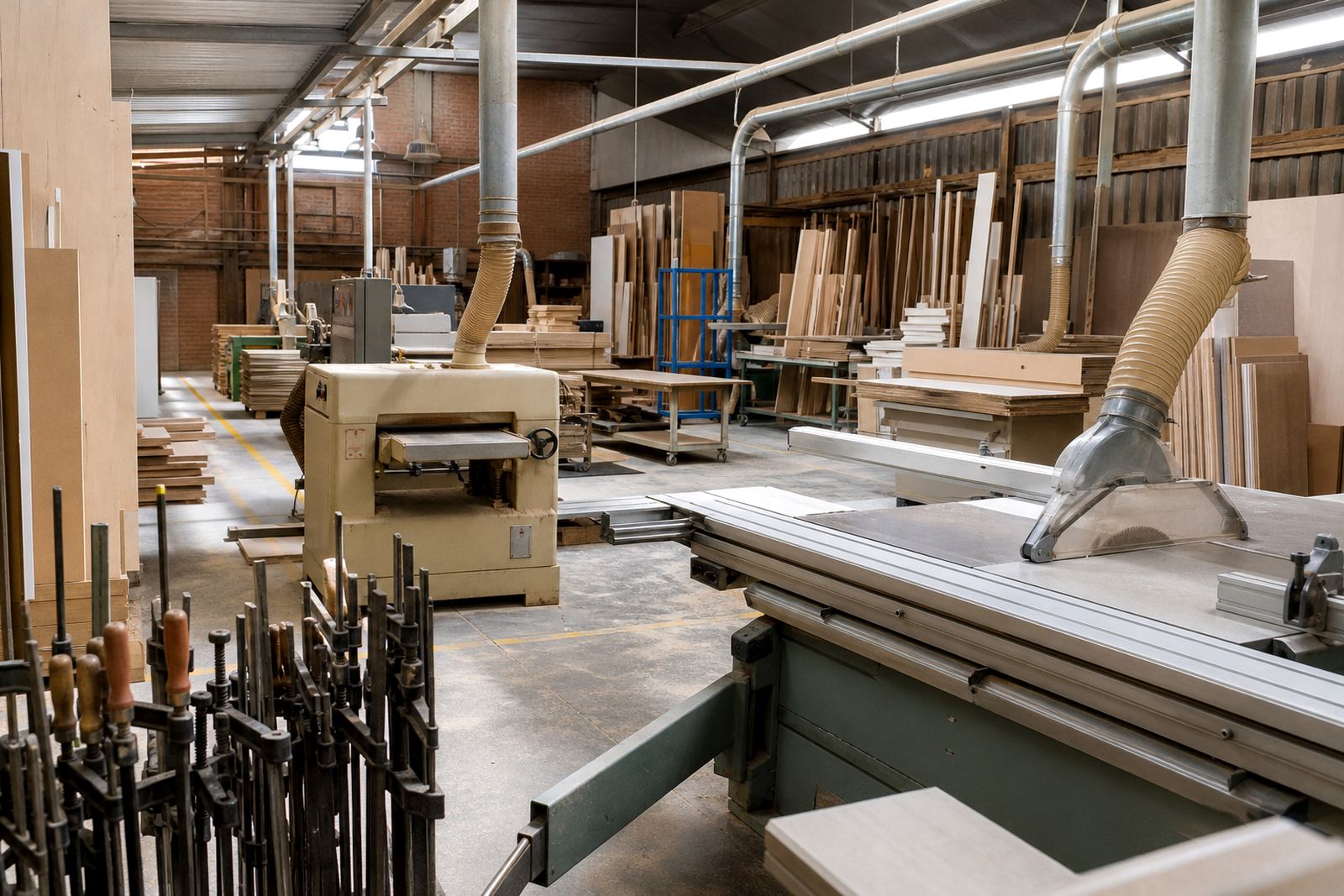
For joinery shops in Gauteng, the challenge is often mixed equipment. You may have a panel saw, edge bander, thicknesser, spindle moulder, planer, morticer, dust extraction and spray booth all in one workshop. Some items are tidy and complete, others have missing guards, worn belts or damaged tables. The aim is to separate what can be sold as a running machine from what should be treated as parts, scrap, or a repair project. That makes the difference between a realistic reserve and a poor outcome.
Typical equipment found in joinery and furniture shops
Every shop is different, but the same core machines come up again and again. We assess the main production equipment as well as the smaller items that often get overlooked during a sale. Accessories matter too, because a machine with the right fences, blades, guides and tooling usually has better value than one stripped bare.
- Panel saws, beam saws and sliding table saws
- Edge banding machines and corner trimming units
- Thicknessers, planers, jointers and surfacing machines
- Spindle moulders, routers and morticers
- Dust extraction units, compressors and vacuum tables
- Cabinet clamps, presses, spray booths and drying racks
- Hand tools, bench machines and spare motors
In coastal cities like Durban or Gqeberha, moisture and salt air can affect bearings, motors and electrical panels if equipment has been stored poorly. In Gauteng, dust buildup and load-shedding damage are common issues. We look at these practical factors because they influence how easily a buyer can put the machine back into service.
How we plan the lotting and sale
Woodworking shops usually sell better when the lotting follows the production flow. That means keeping related machines and accessories together where it makes sense, but not grouping so much that buyers feel forced into a large purchase. A clear plan helps more people bid, especially where a business has a wide mix of cabinet making and furniture finishing equipment.
We review the site layout, access routes, electrical points and removal risks before the sale. Narrow passages, mezzanine storage, fixed dust ducting and machines bolted into concrete can all affect collection. If a workshop is in Kempton Park or Midrand, access may be straightforward for trucks and loaders. In older industrial areas around Germiston or parts of Johannesburg, space is tighter and collection timing needs careful coordination.
- Map the workshop by production area, not just by room
- Identify machines that need dismantling before viewing days
- Separate saleable accessories from workshop consumables
- Check power requirements, phase type and missing parts
- Note any lifting or loading limits before bidders arrive
Clear cataloguing helps buyers understand what they are bidding on. Good photos of serial plates, tables, fences, control panels and tooling can save a lot of back-and-forth later.
Common mistakes sellers make
One of the most common mistakes is assuming every machine should be valued at replacement cost or at the original purchase figure. That is not how the market works. A second mistake is leaving the shop in a state that hides the real condition. Sawdust, offcuts and loose cabling make it harder to see the truth. Buyers will notice anyway, so it is better to show the equipment honestly.
Another issue is leaving too much value tied up in tiny items. Jigs, cutters, clamps, guards, blades and specialised tables can matter, but only if they are correctly listed and grouped. A missing fence or damaged motor mount can reduce interest sharply. It is also a mistake to ignore clearance requirements. If a sale is happening in Cape Town or Durban, building access, loading bays and municipal working hour rules may affect how quickly the premises can be emptied.
Reserve guidance must stay realistic. Too high and bidders stay away. Too low and the seller may not recover fair market interest. We help set a sensible position based on the actual machine, condition and local demand, not wishful thinking.
Budget ranges and practical expectations
Budgets in woodworking shops vary widely, from small garage-style operations to full production lines. For valuation purposes, it helps to think in bands rather than fixed prices. A basic single machine in working order might attract modest interest, while a complete production setup with dust extraction, finishing gear and well kept tooling can reach a much wider buyer base. Condition, age and completeness matter more than the original invoice.
As a practical rule, sellers should budget for the time and effort needed to prepare the sale. That may include cleaning, moving stock, separating non-sale items, and making sure machines can be shown safely on viewing days. If the site has power issues, the team may need to plan around testing limitations. In areas affected by load-shedding, buyers often want to know whether the machine has been started recently and whether control gear is intact. We do not give financial or tax advice, but we do help sellers understand the operational steps that usually affect a sale.
- Small standalone machines are often quicker to place than large production lines
- Complete sets usually need stronger cataloguing and more site control
- Well maintained equipment with tooling can draw better interest
- Non-running machines can still sell, but must be described clearly
Viewing days, inspections and buyer confidence
Buyers in the woodworking sector want to see straight tables, working guards, clean electrics and signs of proper maintenance. That is why viewing days matter. They allow buyers to inspect condition, ask questions and plan removal before bidding. For sellers, this is also the chance to show that the equipment has been described properly and that the shop has been handled in an orderly way.
Asset inspections are especially useful when a workshop has a long production history and several hands have worked on the same machine. A spindle moulder may have been modified, a panel saw may have had guide repairs, and a dust extraction line may have been moved more than once. These details can affect the way a lot is presented. We make note of them so the catalogue reflects what is actually there, not what the machine used to be.
Our team in Kempton Park supports sellers and buyers across Johannesburg, Pretoria, Durban, Cape Town and Gqeberha. Siyabonga Mthembu leads the business, with Pieter van der Merwe handling senior valuation work, Naledi Khumalo managing auctions, and the wider team coordinating catalogues, site logistics and collection planning.
Support from first inspection to closure
Woodworking shop sales often need more than one visit. The first step is usually an on-site inspection and asset review. After that comes auction planning, lotting, reserve guidance and photo listing preparation. If the sale is going ahead, we also help with seller representation, viewing days, collection coordination and closure support. The aim is to keep the process practical and orderly from start to finish.
For businesses in Germiston, Midrand and the greater East Rand, quick access and site control can make a real difference. In busy metro areas, timing matters, and so does communication. Buyers want clear information, and sellers want the premises cleared without delays. That is where careful coordination counts most. If your workshop has joinery machines, furniture production equipment or mixed plant that needs a fair market opinion, Machine Africa can assess it properly and guide the sale process with straight answers and local experience.