Cold Storage Assets Need More Than a Quick Walkthrough
Cold rooms, freezer stores and distribution depots are not valued the same way as general warehousing. A refrigeration system may still look tidy while hidden wear, electrical faults or poor maintenance history affects its value. In a cold chain operation, the condition of compressors, evaporators, insulated panels, dock levellers and backup power support all matter.
Our valuations are opinions of value based on inspection, records where available, and market knowledge. They are not guarantees of sale price. For sellers in Johannesburg, Pretoria, Durban, Cape Town or Gqeberha, the market can shift quickly depending on whether the plant is complete, decommissioned properly, and ready for removal. A well set out cold store with clear access and working support equipment usually attracts stronger interest than a site where the equipment has been stripped bit by bit.
Since 2008, our Kempton Park base has handled machinery for food, beverage, pharmaceutical and logistics operations. The goal is to give you a fair view of what is there, what is still serviceable, and what buyers will likely want to see before they make an offer.
Typical Equipment Found in a Cold Storage Site
A cold storage facility usually includes more than the refrigeration plant itself. We often assess a mix of fixed and movable assets, and each item needs to be described clearly in a catalogue or inspection note. That helps when planning an auction or sale and reduces confusion on viewing day.
- Compressor sets, condensers and evaporators
- Cold room panels, insulated doors and strip curtains
- Racking, pallet positions and shelving
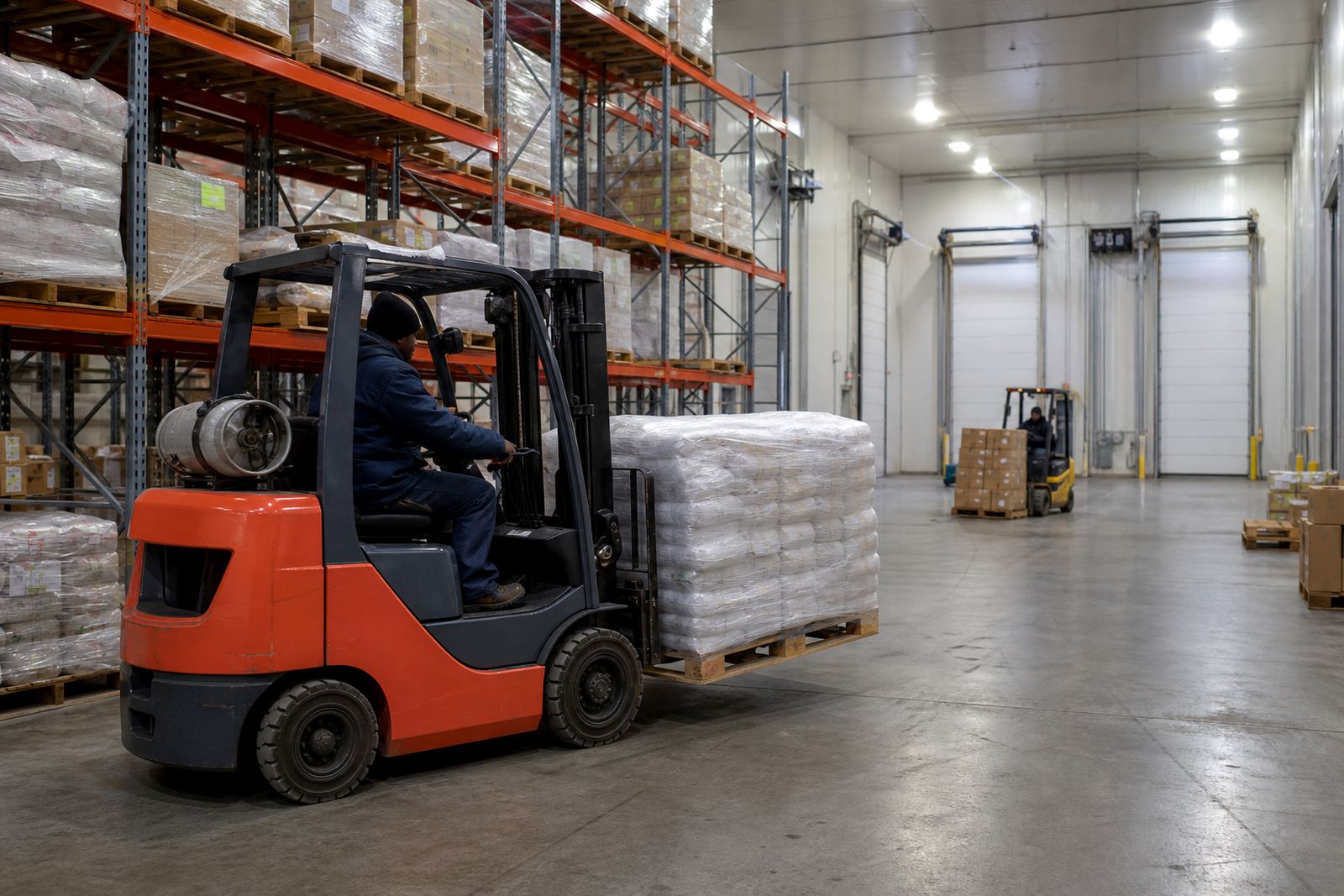
- Forklifts, pallet jacks and reach equipment
- Dock levellers, loading bay equipment and seals
- Temperature monitoring units, alarms and control panels
- Generators, changeover gear and battery backup support
- Wash bay systems, drainage fittings and safety barriers
Condition matters as much as type. A stainless steel trolley used in a clean chilled room may hold value better than one exposed to moisture and salt air near the coast. In Durban and Gqeberha, corrosion is often a bigger issue than people expect, while in Gauteng, load-shedding and electrical stress can affect control boards and backup systems.
How We Plan a Cold Storage Auction or Sale
Good planning starts with a proper site review. We look at the layout, access routes, power isolation points, safe walkways and any lifting or removal limits. In a cold store, poor planning can cause damage to panels, floors and refrigeration lines, so the removal sequence needs to be thought through before the first buyer arrives.
For seller representation, we can help with lotting and cataloguing, reserve guidance, viewing days and closure support. The aim is to group assets in a way that makes sense to buyers. For example, a complete cold room line may be more useful sold as one lot, while forklifts and pallet equipment may perform better as separate lots. A clear lot description also helps buyers understand whether they are bidding on a working asset, a plant item requiring recommissioning, or a unit for spares.
We also assist with photo listing prep and collection coordination so that buyers know what is included and what needs to be removed. In sites around Midrand, Germiston and Kempton Park, we often have to work around active operations, municipal access rules and tight collection windows. That is normal and should be planned from the start, not handled at the end.
Common Mistakes That Lower Real Value
Many cold storage owners wait too long before starting the valuation process. By the time a site is idle, some equipment has already been switched off for months, removed in pieces or left exposed to moisture. That can reduce buyer confidence and make the sale harder to organise. Another common mistake is assuming every item on site will sell at a strong price. In reality, some assets are best treated as support equipment with modest value, while others may carry a better return if they are complete and serviceable.
Another issue is poor records. Buyers want to know age, maintenance history, capacity and whether a refrigeration unit was decommissioned correctly. If those records are missing, the valuation must be more cautious. Municipal compliance can also matter, especially where drainage, noise, gas handling or loading bay traffic have to meet local requirements. If a site has wet floors, damaged insulation or damaged doors, buyers will factor in repair costs quickly.
- Do not strip the site before the inspection is completed
- Do not mix scrap with working assets in the same lot description
- Do not ignore backup power equipment that may still have value
- Do not assume a clean-looking unit is fully serviceable
- Do not delay site access for inspection and catalogue work
Budget Ranges That Buyers and Sellers Commonly Consider
Every cold storage site is different, so budgets need to be treated as planning guides, not promises. In a smaller chilled operation, a seller may be dealing with a few hundred thousand Rand worth of movable equipment, while a larger freezer site can involve a much broader asset base. On the buyer side, the real cost is often not just the hammer price. Removal, transport, lifting gear, recommissioning, and electrical or refrigeration work can add meaningful cost.
For planning purposes, many clients set aside budgets in bands such as R50 000 to R250 000 for smaller support lots, R250 000 to R1 million for mixed plant and handling assets, and above that for larger complete installations. Those figures are only broad working ranges. The actual outcome depends on condition, completeness, access, and how quickly the site must be cleared.
If you are buying for a depot in Pretoria or a distribution centre in Cape Town, factor in power compatibility, floor loading, and whether the equipment suits your product temperatures. A low purchase price can become expensive if the unit needs major refurbishment or if removal is more difficult than expected.
What Buyers Look For on Viewing Days
Viewing days are usually where serious buyers decide how much risk they are willing to take. They will check whether the plant is complete, whether access is practical, and whether the equipment looks maintained. Even a small issue like bent door tracks, missing panels or a noisy compressor can change a bid quickly. For that reason, clear lotting and honest descriptions are important.
Our team works across the region from Kempton Park, Johannesburg and Pretoria through to Durban, Cape Town and Gqeberha. Siyabonga Mthembu leads the business, with support from Naledi Khumalo on auction management, Pieter van der Merwe on senior valuation work, Ayesha Ismail on client relations, Thabo Molefe on operations, Johan Botha on site logistics, and Lerato Nkosi on catalogue and media coordination. That mix helps keep the process practical from first inspection to final clearance.
For sellers, the best result usually comes from a clean site, accurate asset lists and realistic reserve guidance. For buyers, the key is to ask about condition, removal access and whether the equipment fits your cold chain requirements before bidding. That is the difference between a useful purchase and a costly mistake.