Start With the Duty You Actually Need
Before you inspect a chiller unit, match it to the job. A unit that suits a plastics line in Midrand may be wrong for a food plant in Durban or a small workshop in Germiston. Check the cooling load, process temperature, ambient conditions, and whether the unit must run all day or only in shifts. Coastal humidity, summer heat and dust all affect how a used machine will perform once it is back on site.
Ask for the process temperature range, chilled water flow requirement, and the type of application. Some units are better for steady process cooling, while others suit spot cooling or intermittent use. If you are buying for a plant that faces load shedding, plan for restart behaviour, control settings and whether the equipment can recover cleanly after power interruptions.
Check the Nameplate and Basic Identity
Begin with the nameplate and compare it to the physical machine. Record the capacity, power supply, refrigerant type, serial number, compressor count, and year or build reference if available. Make sure the unit offered is the same one shown in the catalogue or viewing photos. For a buyer in Johannesburg or Pretoria, that simple check can save a wasted trip.
- Confirm the stated cooling capacity and power requirements
- Check if the unit is air cooled or water cooled
- Look for evidence of modified wiring or swapped components
- Ask whether manuals, controls and loose parts are included
- Verify that the serial number matches the paperwork and photos
If the seller gives you only partial information, treat that as a sign to inspect more carefully. A valuation is an informed opinion of value, not a guarantee that the unit will sell for a particular amount.
Inspect the Mechanical Condition Up Close
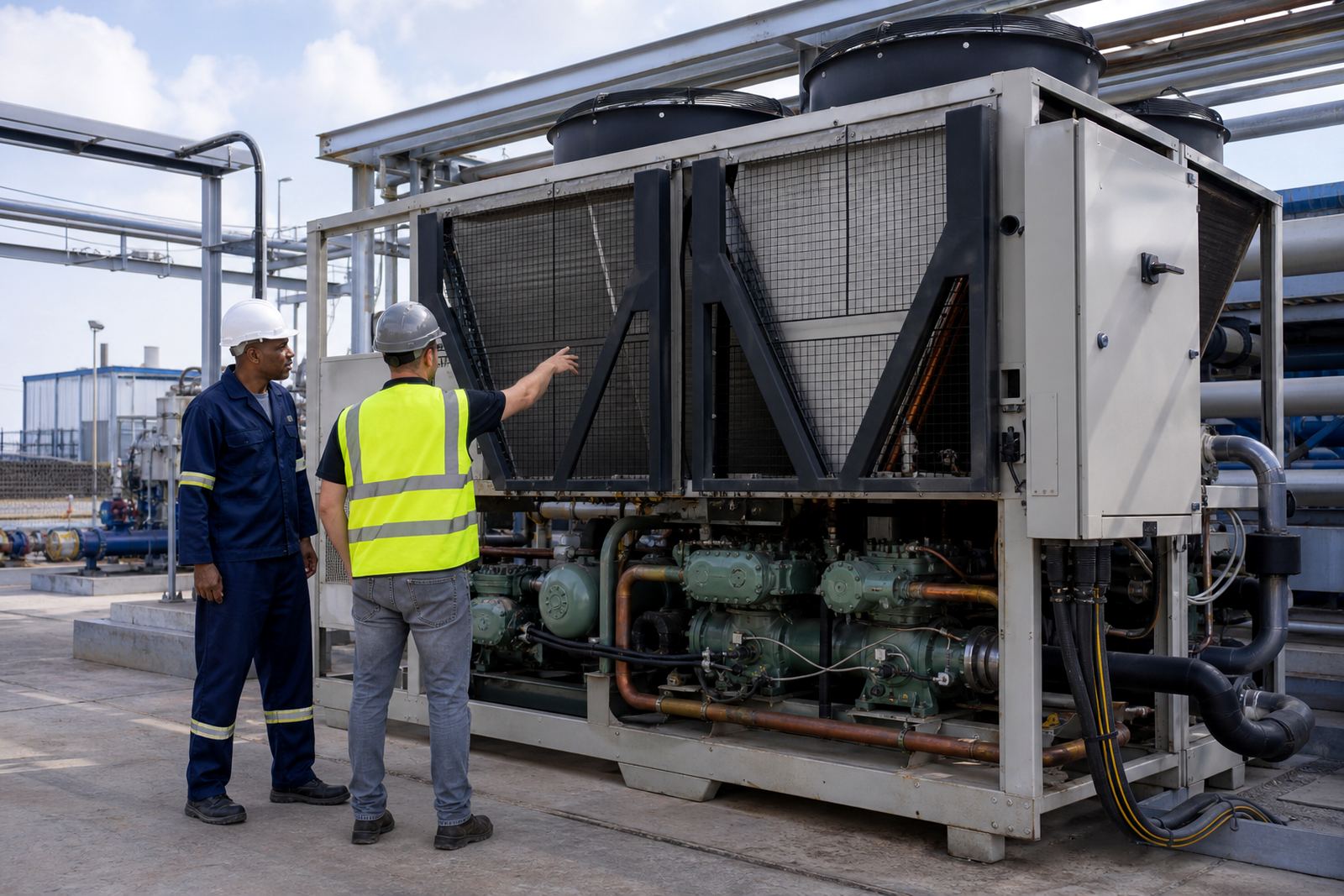
Look at the frame, panels, pipework and insulation before focusing on the compressor. Bent panels, corrosion, oil staining and missing fasteners often point to hard use or poor maintenance. In Gauteng, dusty plant rooms can clog coils and reduce performance, while on the coast rust can appear quickly around fittings and supports. Check for leaks, damaged vibration mounts and signs of overheating around electrical enclosures.
Open what you are allowed to inspect and check the compressor area, fans, pumps and valves. Listen for unusual noise if the unit is briefly energised under proper supervision. If the unit has been standing idle, ask whether it was drained correctly and whether any parts were removed for storage. A clean exterior is helpful but it does not prove the internals are sound.
- Check oil level and look for frothing or contamination
- Inspect pipe joints for staining or fresh sealant
- Look at fan blades, motors and belts where fitted
- Check the evaporator and condenser for visible blockages
- Look for bent fins, loose guards and missing covers
Review Controls, Safety Devices and Electrical Fit
Used chillers often fail at the control level before they fail mechanically. Test the panel if possible, and look at the condition of contactors, relays, terminals, sensors and display units. Controls should be readable and the wiring should be neat, not patched together with loose joints. On older equipment, replacement parts may still be available but lead times can matter if your plant runs on tight schedules.
Check that safety devices are present and not bypassed. Pressure switches, overload protection, emergency stops and flow protection should all be in place. If the machine has been altered for a previous site, make sure the electrical supply on your side can support it. A mismatch between voltage, phase and site capacity can stop a good unit from working as intended.
Ask for Service History and Operational Proof
Service records help you judge how the chiller has been treated. Ask when the last full service was done, what consumables were replaced, and whether there were recurring faults. If there is proof of commissioning, that can help confirm the machine was working at some point, but it still needs a physical inspection. In auction settings, bidders should not assume a unit is fully tested unless that is clearly stated.
Useful paperwork includes service sheets, repair notes, commissioning records, operating manuals and any recent test reports. If the seller cannot provide records, ask more questions during the viewing. A buyer should never rely on guesswork when a chiller is going into production use and downtime could affect the rest of the plant.
- Request the service log and fault history
- Check whether major components were replaced
- Ask when it last ran under load
- Confirm if any parts are missing or stored separately
- Clarify whether the unit is sold as seen or with any test notes
Plan the Move, Reinstall and Start-Up
Many buyers focus on the purchase and forget the move. Chiller units can be heavy, awkward and sensitive to poor handling. Measure access routes, door widths, loading points and crane needs before collection day. Johannesburg industrial parks, Cape Town factory yards and Durban coastal sites all present different access challenges. Make sure the unit can be lifted, loaded and positioned without damage to pipework or control panels.
Also plan the reinstallation. You may need a qualified technician to reconnect electricals, water lines and controls, then check for leaks and correct flow. If the unit has been idle for a while, it should be inspected before the first start-up. That extra step costs time but it may save a bigger repair later.
Use Viewing Day to Ask the Right Questions
Viewing day is where careful buyers separate the usable units from the risky ones. Bring a checklist, a camera and if possible a technician who understands process cooling. Walk around the machine slowly and ask direct questions about how it was used, why it is being sold, and what support is available after sale. If the equipment is being sold through an auction process, make sure you understand the bidding rules, viewing times and collection timetable before you raise your hand or place a bid.
For sellers, a clean lotting and cataloguing process helps buyers inspect the right details. Clear photos, honest descriptions and well planned viewing days help keep the process transparent. For buyers, the safest approach is simple: inspect thoroughly, budget for moving and recommissioning, and only bid on a unit that fits your site and duty.
Machine Africa works with sellers and buyers across Kempton Park, Johannesburg, Pretoria, Durban, Cape Town, Gqeberha, Germiston and Midrand. Our team handles on-site valuations, auction planning, asset inspections, reserve guidance, viewing days, seller representation, collection coordination, clearance sales, closure support, plant appraisals and photo listing prep.