
Start with the job, not the badge on the machine
The first mistake many buyers make is chasing a familiar machine name before checking whether it suits the task. A catalogue description should tell you what the machine does, its size, its power source, its main tooling and any limits on use. For a workshop in Kempton Park or a plant in Durban, that can matter more than age alone.
Look for details such as bed length, spindle size, table dimensions, motor rating, voltage, and whether the machine is manual, semi automatic or fully automatic. If the listing is thin on detail, treat that as a signal to inspect carefully. A good catalogue note should reduce uncertainty, not create it.
- Match the machine to your actual output needs, not just the model type
- Check capacity, power requirements and footprint before you attend
- Read whether tooling, controls or attachments are included
Read condition language with care
Words like used, working, untested, removed from service and running at time of inspection can mean very different things. In auction catalogues these phrases are important because they show what has been confirmed and what has not. If a note says the item was last in operation, that is not the same as a full service history or a guarantee that it will start on the day you view it.
Pay attention to signs of wear that are written into the lot note. Missing guards, cracked glass, oil leaks, corrosion, loose cables, worn chains or damaged beds all change how you should value the machine for yourself. On the coast, especially around Gqeberha and Durban, rust can move quickly on idle equipment and that should be taken seriously.
- Untested means exactly that, it has not been proved under load
- Running at time of inspection only confirms one moment in time
- Look for mention of repairs, modifications or missing parts
Use the photos as evidence, not decoration
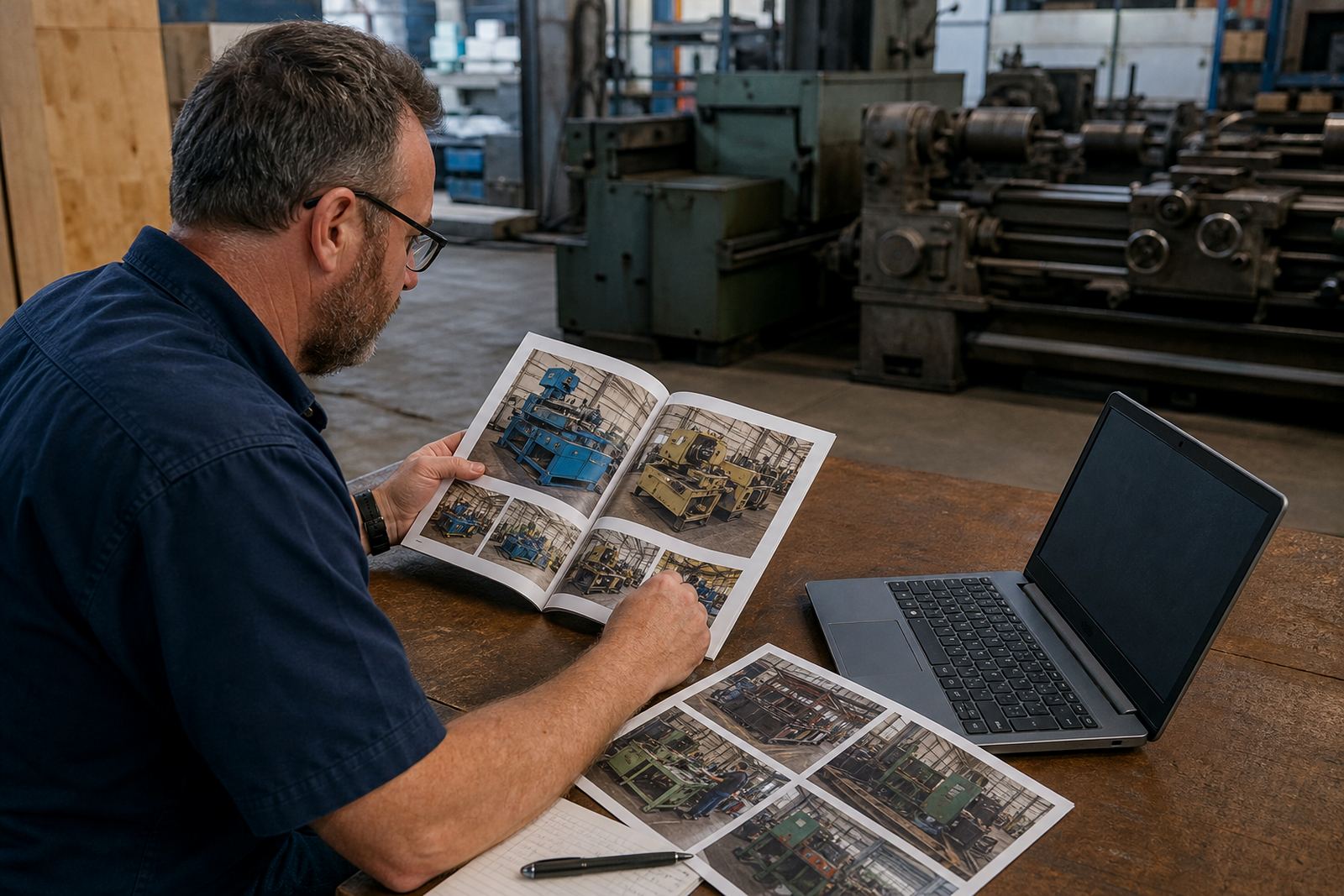
Images are one of the most useful parts of a catalogue if you know how to read them. Do not only look at the front view. Check the rear, the motor area, the control panel, the bed, the tooling, the nameplate and the floor around the machine. Oil stains, temporary wiring and patch repairs often show up in photos before they are mentioned in the text.
A clean photo does not always mean a clean machine. Sometimes a machine is wiped down before cataloguing, and sometimes poor lighting hides cracks or worn surfaces. If the photo set is limited, take that into account when you decide whether to bid. One blurred image of a critical part should prompt more questions not fewer.
- Zoom in on serial plates, labels and control panels
- Check whether all sides were photographed
- Compare the picture with the written lot note for gaps
What lot notes are really telling you
Lot notes are there to give you practical warnings and useful context. They may mention access limits, dismantling needs, a time slot for viewing, a power supply issue, or a machine that could not be tested in full. They may also point out if an item is mounted, bolted down or grouped with other equipment. That matters when you are planning removal from a site in Midrand or Germiston.
Take note of anything that affects collection. If the note mentions forklift access, overhead obstructions, stairs, a narrow doorway or a need for a crane, factor that into your plan. A bidder who overlooks logistics can end up paying more in handling than expected, even before transport to Pretoria or Cape Town is arranged.
- Access notes can affect the true cost of purchase
- Grouped lots may include more items than the main photo shows
- Removal conditions often matter as much as the hammer price
Use valuations as a guide, not a promise
When a catalogue includes a valuation or opinion of value, treat it as informed guidance based on the machine’s apparent condition, age, market demand and sale context. It is not a guarantee of sale price. At auction, final outcomes depend on buyer interest, timing, location, asset type and the condition confirmed on the day.
That is why experienced buyers compare the valuation with the lot notes, the photos and the planned use. A machine valued for general market purposes may still be a good buy for a specific workshop, or poor value if it needs repairs you cannot do locally. In South Africa, where transport and lifting costs vary between provinces, the right number is often the one that leaves room for collection and setup.
- A valuation is an opinion of value, not a sale promise
- Market demand changes from one auction to the next
- Your own repair and transport costs should be added separately
A practical reading method for buyers in South Africa
If you are viewing catalogues from Johannesburg, Pretoria, Durban, Cape Town or Gqeberha, work through each lot the same way. First, check the description for size, function and power. Second, read the condition note for known faults or missing items. Third, study the photos for wear and signs of recent use. Fourth, decide whether you need to inspect the machine in person before bidding.
For example, a fabrication shop in Kempton Park may see a press brake listed with a decent profile and assume it is ready to go. But if the note says the machine has not been powered on, has surface rust on the bed and needs a missing foot switch, the real question becomes whether the purchase still makes sense once those points are costed in. That is how careful buyers avoid surprises.
- Shortlist only the lots that match your budget and capacity
- Visit viewing day if the note leaves any uncertainty
- Plan for power, transport and installation before you bid